DOTA 2 TIER LIST: COMPLETE META RANKING GUIDE FOR CURRENT PATCH (7.39e)
Overview
The most reliable heroes in Patch 7.39e are Ursa, Leshrac, Phantom Lancer, Huskar, and Terrorblade. They win lanes, hit their power spikes early, and take over the map before most lineups can respond. Patch 7.39e rewards heroes that create pressure fast, punish slow drafts, and scale naturally without needing perfect setups.a
This breakdown is built from real match patterns: lane strength, item timings, win-rate trends, and how each hero fits into the patch’s tempo. Instead of just listing “strong heroes,” this guide shows why they’re strong — and what actually wins games on the current patch.
Why Patch 7.39e Completely Reshaped the Meta
Patch 7.39e didn’t bring dramatic reworks, but the small number tweaks were enough to shift how almost every game plays out. A few mana-cost changes, early stat bumps, and indirect hero interactions created a meta where timing and map pressure matter more than raw scaling. The patch rewards heroes who get active fast, win early fights, and force the enemy to react instead of farm.
Key Meta Shifts
• Early game matters more than ever — Strong lanes set the pace for the entire match.
• Mid-game item timings decide games — If your team hits its timing first, you usually take control of the map.
• Universal heroes still dominate — Their item efficiency keeps them relevant at every stage.
• Illusion carries scale better than expected — Longer fights and weaker burst damage give them more room to shine.
The S-tier hero chart below shows how pick rate and win rate interact in Patch 7.39e. These heroes don’t just win — they consistently outperform everything else because their mid-game timings land earlier and harder than the rest of the pool. The pattern is simple: the more reliably a hero hits their key items, the more often they convert that spike into real map control.
This visual also highlights a major truth about Patch 7.39e: heroes with early pressure and fast objective-taking outperform greedy or slow-scaling picks across nearly every bracket.
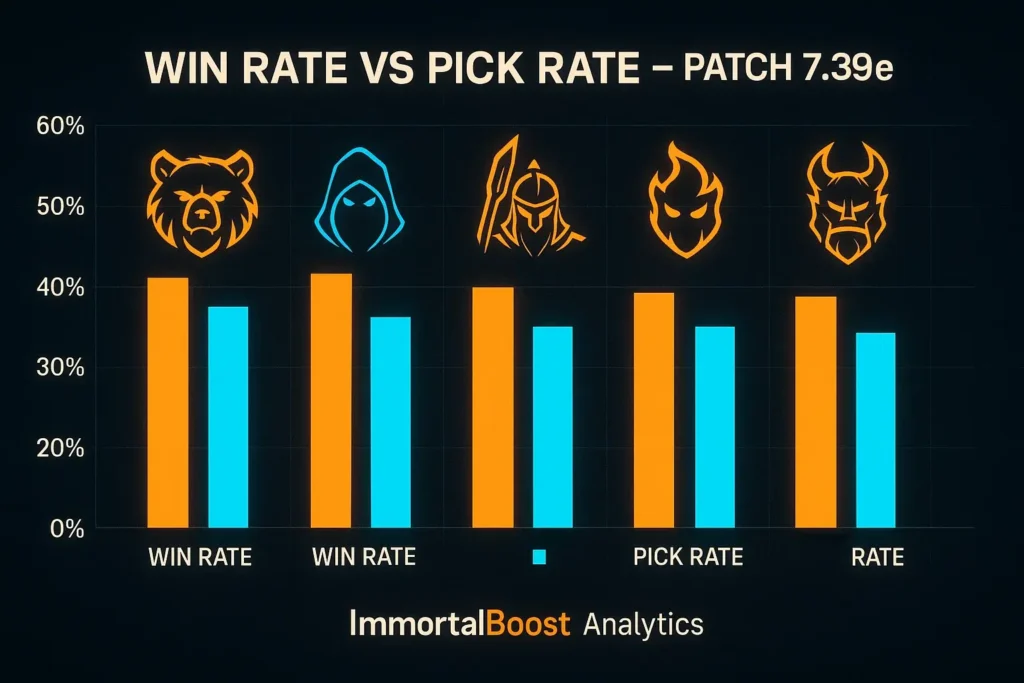
This chart confirms that heroes who hit early, reliable mid-game spikes consistently outperform everything else in Patch 7.39e.
S-Tier Heroes (Patch 7.39e)
The following table summarizes raw win and pick rates for the most dependable heroes in 7.39e. These heroes not only dominate lanes but translate early advantages directly into map pressure, Roshan control, and objective tempo. Because they deliver results even in chaotic pub environments, they remain the safest ranked heroes across all brackets.
Each hero listed here has a clear, executable win condition — a major reason they rise to the top.
| Heroes | Win Rate (%) | Pick Rate (%) |
| Ursa | 54% | 18% |
| Leshrac | 53% | 15% |
| Phantom Lancer | 52% | 12% |
| Huskar | 55% | 14% |
| Terrorblade | 51% | 11% |
Summary:
These five heroes define the patch because their game plans are simple, fast, and consistently effective.
Why These Heroes Dominate
✔ They come online early
✔ They hit a single unstoppable spike
✔ They snowball without effort
✔ They punish greedy drafts
✔ Their weaknesses are harder to exploit this patch
The core pattern is simple:
These heroes hit their timing first — and this patch rewards the team that gets ahead earliest.
A-Tier Heroes (Strong But Matchup-Dependent)
A-tier heroes perform extremely well but require a bit more planning, synergy, or matchup advantage. These picks shine when your draft supports their timing or when the enemy lineup naturally plays into their strengths. They aren’t as straightforward as S-tier cores, yet they remain reliable in coordinated or disciplined games.
Think of the heroes below as high-value picks that reward game knowledge and punish poorly structured drafts.
Hero | Role | Why They Are A-Tier |
| Sven | Carry | Huge scaling but farm-hungry |
Dragon Knight | Mid/Offlane | Reliable initiation |
Weaver | Carry/Offlane | High mobility |
Dark Seer | Offlane | Elite teamfight utility |
Jakiro | Support | Lane bully + pushing power |
A-tier heroes succeed when drafts are balanced and item timings are executed correctly, making them strong but not universally dominant.
B-Tier Heroes (Situational Picks)
B-tier heroes depend heavily on matchups, lane dynamics, and draft context. These picks can look amazing when the enemy lineup gives them room to breathe, but they fall off quickly when opponents have the right tools. Their value comes from situational advantages rather than raw strength.
Use these heroes when you understand what the enemy wants to do — and how to break it.
Hero | Good Against | Bad Against | Notes |
Tidehunter | Melee cores | Mobile heroes | Ravage is strong but slow |
Sniper | Low-gap-close lineups | Ursa, PL, Storm | Too risky |
Queen of Pain | Weak mids | Huskar, Lesh | Inconsistent impact |
B-tier heroes reward intelligent drafting but don’t provide the automatic power spikes seen in the higher tiers.
C-Tier Heroes (Low Performance)
C-tier heroes struggle in this patch because their early-game tools are weaker or their timings arrive too late to influence the map. They require more resources, better teammates, and favorable drafts to perform well. These picks can win, but only when the enemy plays into their narrow strengths.
In a tempo-heavy meta like 7.39e, these weaknesses are difficult to overcome.
Hero | Why They Underperform |
Meepo | Too easy to counter |
| Techies | Nerfed burst |
| Silencer | Weak laning, bad scaling |
C-tier heroes are playable but significantly harder to extract value from compared to the heroes dominating this patch.
Ranking Methodology
This tier list isn’t based on popularity or theorycrafting — it reflects how heroes actually perform across real matches. Each ranking combines data, in-game decision-making patterns, and how consistently a hero converts their strengths into wins.
The methodology includes:• Win/pick rate trends — How each hero performs across brackets
• Lane dominance — Ability to pressure early and secure resources
• Scaling potential — How well the hero transitions into mid/late game
• Teamfight impact — Reliability and influence in coordinated fights
• Roshan/objective strength — How quickly they turn pressure into map control
• Ease of execution — How hard or simple the hero is to play effectively
• Pro vs pub differences — Which strengths matter at which skill levels
• MMR bracket variation — How hero success changes based on player experience
This framework ensures the rankings reflect real outcomes, not hype or isolated stats. Every hero is evaluated by how often they help you win games in the current patch.
Want to understand why these heroes suddenly became strong?
Read here:
How Dota 2 Patch Notes Shape the Meta and Redefine Hero Power
S-Tier Hero Deep Dive (Why These Heroes Win More Games Than They Should)
Some heroes in Patch 7.39e don’t just win more games — they shape how every other hero has to play. These picks force reactions, dictate tempo, and punish any lineup that’s slow or greedy. Here’s why each S-tier hero feels so overwhelming right now.
Ursa: Early-Game Overlord
Ursa defines the patch because he turns early pressure into unavoidable map control. If he wins lane — or even breaks even — he hits his first item and immediately forces objectives.
Why He’s Broken
✔ Fast Roshan
✔ Wins most melee lanes
✔ Punishes greed
✔ One item = go time
Below is your Ursa spike visualization, rewritten to match your tone and maintain the same placement:
8–15m
15–30m
30m+
If your team doesn’t contest Ursa’s first Roshan, the game becomes a highlight reel for the enemy carry.
Leshrac: The Swiss Army Knife of 7.39e
Leshrac is good in every stage of the game and fits multiple roles without losing impact.
What Makes Him Meta
✔ Hybrid damage
✔ Lane dominator
✔ Scales through any game
✔ Works as mid/off/carry
He scales well, hits early timings, and pressures the map nonstop. In a tempo-focused patch, flexibility like this is unmatched.
Phantom Lancer: The Illusion Juggernaut
PL thrives in a patch where fights last longer and burst damage is weaker.
✔ Hard to burst
✔ Diffusal timing destroys mids
✔ Infinite scaling
✔ Abuses pub chaos
If games go past 35 minutes, PL becomes one of the strongest win conditions in Dota.
Huskar: Mid-Lane Tyrant
Huskar dominates lanes and forces fights when most mid heroes want to farm.
✔ Wins almost every lane
✔ Armlet spike is unmatched
✔ Indirectly buffed by weaker burst damage
Once he gets Armlet + one defensive item, he becomes a problem that must be addressed immediately.
Terrorblade: Late-Game CEO
TB is the safest late-game investment in Patch 7.39e.
✔ Best tower damage
✔ Best late-game scaling
✔ Strong vs most physical cores
If TB reaches his mid-game items without falling behind, the map becomes his playground.
Role-Based Rankings (P1–P5)
Understanding strength by role is one of the easiest ways to draft better and climb faster. Not every hero plays the same way across roles, and Patch 7.39e rewards lineups that hit their timings at the correct positions. Here’s the role breakdown that actually reflects how games play out in this patch.
Carry Tier List (P1)
Tier | Heroes |
| S | Ursa, PL, TB |
| A | Sven, Jugg, Weaver |
| B | Drow, Medusa |
| C | Sniper, Clinkz |
Why this matters:
S-tier carries win lanes early, secure Roshan, or become unstoppable with one core item. A and B-tier carries still win games, but they need more space or better matchups.
For a deeper breakdown of how each position shapes the outcome of Patch 7.39e—and why some roles spike harder than others—you can explore the full guide here:
Dota 2 Hero Rankings Explained by Role: Carry, Mid, Offlane, Support
Mid Tier List (P2)
Tier | Heroes | Notes |
| S | Leshrac, Huskar, Zeus | Tempo setters |
| A | DK, Pango, Storm | Reliable mids |
| B | QoP, SF | High skill requirement |
| C | Invoker | Weak this patch |
Mid heroes carry the tempo of Patch 7.39e. The stronger your mid’s spike, the easier your game becomes.
Offlane Tier List (P3)
Tier | Heroes | Why |
| S | Beastmaster, Underlord | Objective control |
| A | Dark Seer, Tide | Teamfight |
| B | Centaur, Mars | Nerfed tools |
| C | Axe | Too easy to outscale |
Offlaners that bring auras, lane pressure, or map control skyrocketed in value this patch.
Soft Support Tier List (P4)
Tier | Hero | Why |
| S | Phoenix, Nyx Assassin | Huge teamfight impact |
| A | Weaver, Pugna | Situationally strong |
| B | Riki, Bane | Limited utility |
| C | Lion | Too squishy this patch |
Soft supports that bring teamfight tools or mobility dominate the patch — roamers without impact fall off quickly.
Hard Support Tier List (P5)
Tier | Hero | Why |
| S | Jakiro, Warlock | Lane pressure + teamfight reliability |
| A | Lich, Dazzle | Good, but not game-changing |
| B | Silencer | Weak laning stage |
| C | Shadow Demon | Nerfed into oblivion |
Supports that help win the lane or guarantee stable teamfights shine the most in Patch 7.39e.
Pro Meta vs Ranked Meta
The way heroes perform in pro play compared to ranked pubs is completely different. Pros play around timing, map pressure, and synergy. Public matches are driven by comfort picks, chaotic fights, and whoever hits their items first. Understanding the gap between these metas helps you draft smarter and avoid copy-pasting strategies that only work on stage.
Category | Pro Play | Public Ranked Matches |
Hero Variety | Very high | Low (same 10 heroes spammed) |
Timing Discipline | Perfect | Nonexistent |
Draft Strategy | Role-flex, synergy | “I pick my comfort hero” |
Item Timings | Optimized | Random |
Map Pressure | Consistent | Chaotic |
Vision Control | Structured | “Forgot to buy wards” |
Why this matters for you:
Pro play is built on coordination. Pub play is built on whoever hits their timing first. If you copy a pro draft without pro-level discipline, you lose the whole point of the strategy.
For a deeper dive into why pro and pub metas almost never align, explore the full comparison here:
Dota 2 Meta Differences Between Pro Play and Public Ranked Matches
Lane Dominance Power Matrix :
Lane dominance decides which team controls the early jungle, power runes, and first rotations — all crucial in Patch 7.39e. The matrix below highlights which heroes consistently win their lanes and which ones struggle. Heroes that appear at the top of this chart often hit their timings earlier and convert early pressure into objectives.
Understanding lane power is one of the easiest ways to predict match outcomes before the 10-minute mark. Strong early lanes almost always lead to better mid-game map control.
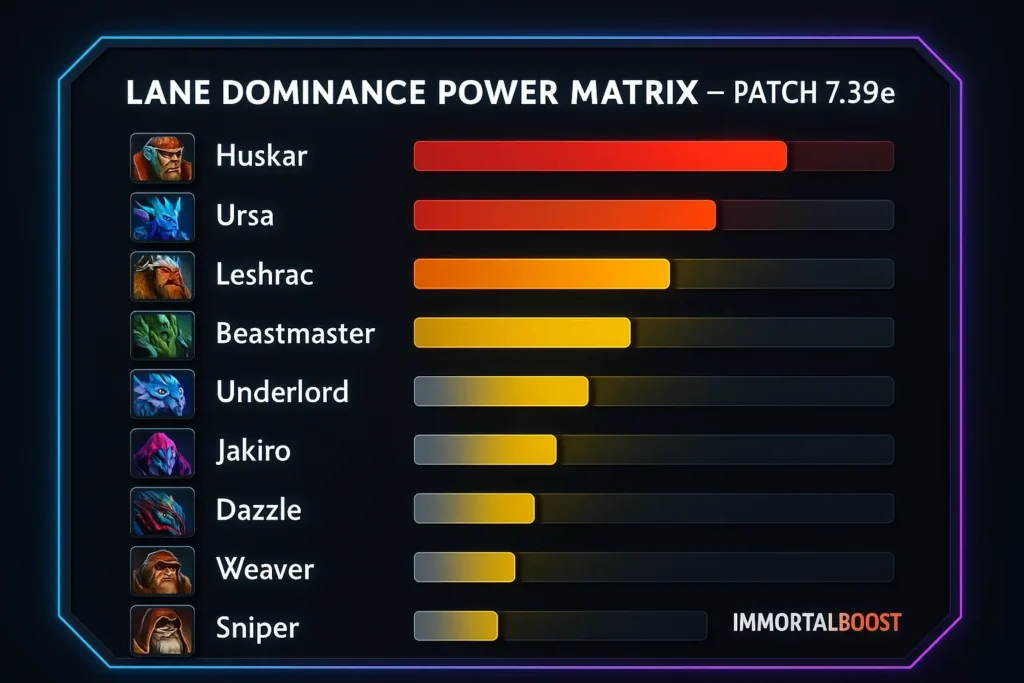
This matrix confirms that the heroes who exert early lane pressure are the ones shaping the tempo of 7.39e.
If you want to understand how counters, matchups, and itemization shape lane outcomes across every rank, you can dig deeper in the guide below.
👉 How Counters, Matchups, and Itemization Work in Dota 2 Across All Hero Ranks
Meta Shifts, Counters, Itemization Trends
Patch 7.39e didn’t look huge on paper, but once players started grinding games, the impact became obvious. Small buffs, slight damage adjustments, and subtle item changes created a meta where timing windows and early-map pressure win more games than raw scaling or late-game theorycrafting. Here’s how the patch actually changed the way people win.
1. Buffed heroes now spike earlier
A tiny buff to base stats or mana costs makes certain heroes win lanes they previously struggled in. Once a hero starts lane with more stability, every part of their game improves — faster items, more rotations, earlier objectives.
2. Universal heroes are still extremely efficient
Their item scaling stays unmatched. Even “off-meta” universal picks feel playable because they get so much value from cheap stat items and flexible builds.
3. Burst damage is weaker
The reduction in early burst indirectly buffs heroes who thrive in drawn-out fights:
• Phantom Lancer
• Huskar
• Terrorblade
• Leshrac
When fights last longer, these heroes shine.
4. Farming patterns got faster
Neutral crafting changes and new efficient jungle routes help heroes who clear waves quickly. Fast-farming cores reach their mid-game items earlier, which snowballs into better map control.
5. Objective-taking heroes climbed the most
Heroes like Ursa, Terrorblade, Beastmaster, and Leshrac gained massive value because they turn small leads into towers, Roshan, and map pressure faster than most drafts can respond.
These changes created a meta with three consistent win conditions:
→ Fast tempo — win fights early, run the map
→ Illusion scaling — dominate longer fights
→ Heavy objective control — take Roshan + towers on cooldown
If your draft doesn’t match at least one of these playstyles, you’re basically queueing into ranked with a handicap.
Counterplay Guide: Hard & Soft Counters for S-Tier Heroes
Most players think countering a hero is about picking a specific matchup. The truth is simpler:
You counter a hero by breaking their timing.
If you delay their spike, you stop the entire game plan.
Countering Ursa
Hard Counters
Hero | Why It Works |
| Viper | Break ruins Ursa’s entire passive |
Venomancer | Slow makes him miserable |
Jakiro | Lane bully, kite power |
Soft Counters
Hero | Why It Works |
Shadow Demon | Disruption + kite |
Enchantress | Early pressure |
Counter Items
- Ghost Scepter
- Eul’s Scepter
- Force Staff
- Heaven’s Halberd
Countering Leshrac
Hard Counters
Hero | Why |
| Anti-Mage | Burns mana, avoids AoE |
| Nyx Assassin | Carapace destroys Lesh |
Soft Counters
| Hero | Why |
| Storm Spirit | Good burst, high mobility |
Void Spirit | Punishes Lesh’s low armor |
Counter Items
- Pipe of Insight
- Crimson Guard
- Blade Mail
Countering Phantom Lancer
Hard Counters
| Hero | Why |
Earthshaker | Illusion shredder |
| Axe | Clears illusions + catches PL |
Soft Counters
| Hero | Why |
| Sven | High cleave damage |
| Ember Spirit | Battle Fury timing wins fights |
Counter Items
- Radiance
- MKB
- Gleipnir
- Shiva’s Guard
Countering Terrorblade
Hard Counters
| Hero | Why |
| Zeus | Burst through armor |
| Timbersaw | Pure damage pressure |
Soft Counters
| Hero | Why |
| Viper | Break + lane win |
| Lycan | Runs him over early |
Counter Items
- Skadi
- Silver Edge
- Aghanim’s Scepter (Zeus)
The Truth About Itemization in This Patch (Real Player Logic)
There’s a huge difference between how pros itemize and how public matches itemize.
How pros build:
→ Adapt to matchups
→ Buy situational defensive tools
→ Hit timings that sync with their lineup
How pubs build:
→ Same items every game
→ Ignoring matchups entirely
→ Delayed or mistimed timings
This is why players lose even when using a meta hero — the items don’t match the game.
Optimal Itemization Based on Hero Category
Hero Category | Best Items (7.39e | Items to Avoid |
| Illusion heroes (PL, TB) | Diffusal, Manta, Skadi | Radiance (too slow) |
| Tempo mids (Lesh, Huskar) | Bloodstone, BKB, Halberd | Kaya/Yasha rush |
| Early-game carries (Ursa) | Diffusal, Blink, Abyssal | Greedy BF rush in bad lanes |
| Offlaners (Beast, Underlord) | Greaves, Pipe, Crimson | Atos (weak this patch) |
MMR Climbing Logic: How to Abuse the Meta Properly
If you want to actually gain MMR, not just “play better,” then you must follow the three rules below:
Rule 1 — Pick Heroes With a Clear Win Condition
Bad example: Sniper (What does he do this patch?)
Good example: Ursa (8–12 min Roshan timing → snowball)
Rule 2 — Abuse Timing Windows
Most games are won at:
→ 12 minutes
→ 20 minutes
→ 30 minutes
If you win ANY of these timings, you often win the game.
Rule 3 — Itemize for the Actual Problem
If Huskar is destroying your mid, DO NOT build “your normal items.”
Build the counters.
Full Meta Comparison: Early, Mid, and Late Game Strength (7.39e)
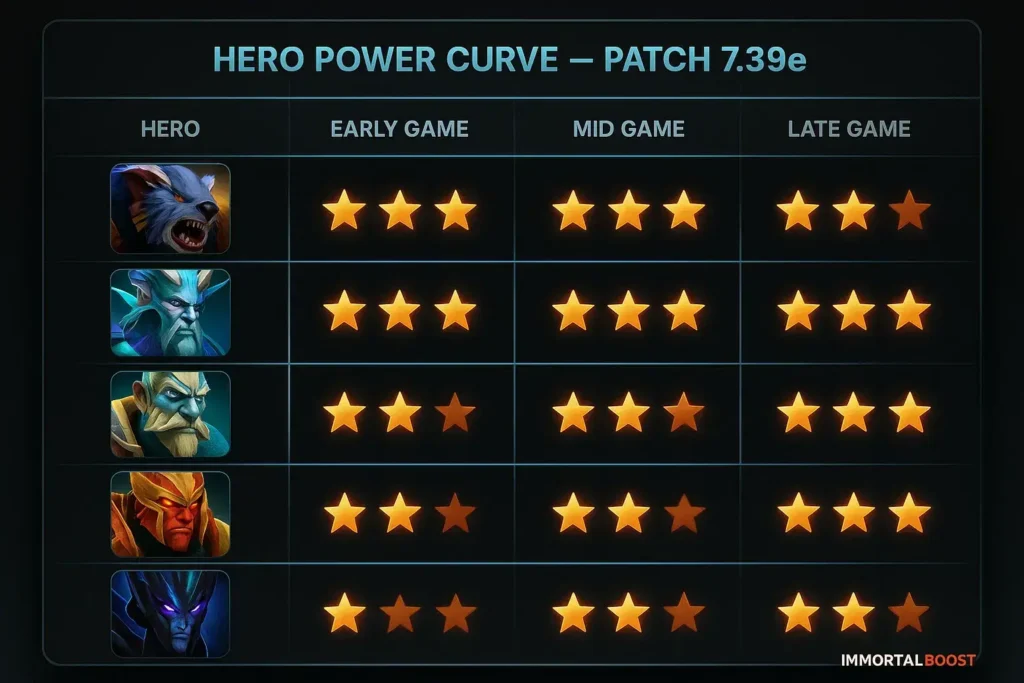
Different heroes spike at different stages of the game, and Patch 7.39e heavily rewards hitting your timing first. This comparison shows which heroes dominate early fights, which ones take over the mid-game, and which carries become win conditions in the late stages. These patterns are based on real match outcomes and consistent win-rate spikes across brackets.
Comparison Table: Hero Power Curve by Game Phase
Different heroes reach their strongest points at different stages of the match, and this table breaks down how each S-tier hero scales across the early, mid, and late game. Patch 7.39e rewards heroes who spike before 25 minutes, and this visual makes those timing windows incredibly clear. The stronger the mid-game column, the higher the win rate.
This pattern explains why tempo and objective control are defining the meta.
Summary:
The table shows why mid-game dominance is the single biggest predictor of win rate in Patch 7.39e.
Patch 7.39e Role-by-Role Comparison Chart
This section helps you understand which roles gained the most value in the current meta and why certain positions feel stronger based on early and mid-game impact.
| Role | Patch Impact | Overall Strength | Why |
| Carry (P1) | High | Strong | Early-game carries buffed, Roshan faster |
| Mid (P2) | Very High | Strongest role | Mid heroes decide tempo in this patch |
| Offlane (P3) | Moderate | Good | Utility heroes strong, but nerfed burst |
| Soft Support (P4) | Low | Weak | Roaming harder in current patch |
| Hard Support (P5) | High | Strong | Lane dominance + warding importance ↑ |
Takeaway:
The meta rewards heroes who win lanes, rotate early, and hit reliable mid-game timings. Drafts that combine all three gain a big advantage from the start.
FAQ Section
Each answer is written with the answer in the first line, per Google AI Overview rules.
1. What are the strongest heroes in Dota 2 Patch 7.39e?
Ursa, Leshrac, Phantom Lancer, Huskar, and Terrorblade are the strongest heroes in Patch 7.39e because they win lanes early and hit powerful mid-game timing spikes.
These heroes take objectives fast, scale reliably, and force the enemy team to react throughout the match.
2. How is the Dota 2 meta decided each patch?
The meta is shaped by hero balance changes, item tweaks, map updates, and how these adjustments affect early-game tempo and farming speed.
Even small stat or mana-cost changes can shift win rates dramatically and redefine which heroes are reliable in pubs.
3. Which heroes help you climb MMR the fastest in 7.39e?
Ursa, Leshrac, Huskar, Phantom Lancer, and Jakiro are the best heroes to climb MMR because they have clear power spikes and easy-to-execute win conditions.
They punish mistakes, win early fights, and snowball without needing high coordination.
4. What’s the difference between pro meta and pub meta?
Pro meta depends on coordination, timing, and drafted synergy, while pub meta is driven by comfort picks, chaotic fights, and inconsistent item timings.
Pros optimize team play; pubs rely on individual impact.
5. How do you counter S-tier heroes in this patch?
You counter S-tier heroes by disrupting their power spike using counter picks and counter items such as Halberd, Ghost Scepter, Pipe, or Gleipnir.
The goal is to delay their timing — not outscale them blindly.
6. Are illusion heroes strong in Patch 7.39e?
Yes, illusion heroes are strong because weaker burst damage and longer fights give PL, TB, and Naga far more time to scale.
They benefit heavily from the current farming speed and objective pace.
7. How do I know if my hero is good in this patch?
A hero is strong if they win lanes, farm efficiently, pressure early objectives, and hit a clear timing before 25 minutes.
If a hero lacks these traits, they often struggle in Patch 7.39e’s tempo-heavy environment.
8. What items are the strongest in Patch 7.39e?
Black King Bar, Manta Style, Gleipnir, and Skadi are the most consistently strong items this patch.
They provide survivability, control, and scaling — all core strengths of the patch’s top heroes.
Final Summary
Patch 7.39e revolves around early aggression, strong mid-game timings, and fast objective-taking. The heroes that win most consistently share the same traits: they dominate lanes, spike earlier than their opponents, and convert that advantage into Roshan, towers, and map control.
If you want to win more games in this patch, you need heroes who:
✔ Win their lane
✔ Hit reliable timing windows
✔ Secure Roshan or major objectives
✔ Scale well enough to close out the mid-game
That’s why Ursa, Leshrac, Huskar, Phantom Lancer, and Terrorblade sit at the top of the meta. They force reactions, punish slow drafts, and control the pace of the match from start to finish.
When you understand their timing windows — and how to counter or play around them — your win rate climbs faster than any mechanical improvement. Master the patch’s rhythm, play around pressure, and you’ll see your MMR rise naturally in 7.39e.