


You just finished your placement matches and landed in Gold. Or you’ve been grinding Silver for three weeks and can’t seem to break through. Either way, if you don’t understand how Rocket League’s ranking system actually works, the ranks in order, your MMR, and where you sit in the rank distribution, you’re fighting the system blind. This complete guide covers every Rocket League rank, the current rank distribution and percentages, how MMR works, placement matches, and the tips that actually help you climb.
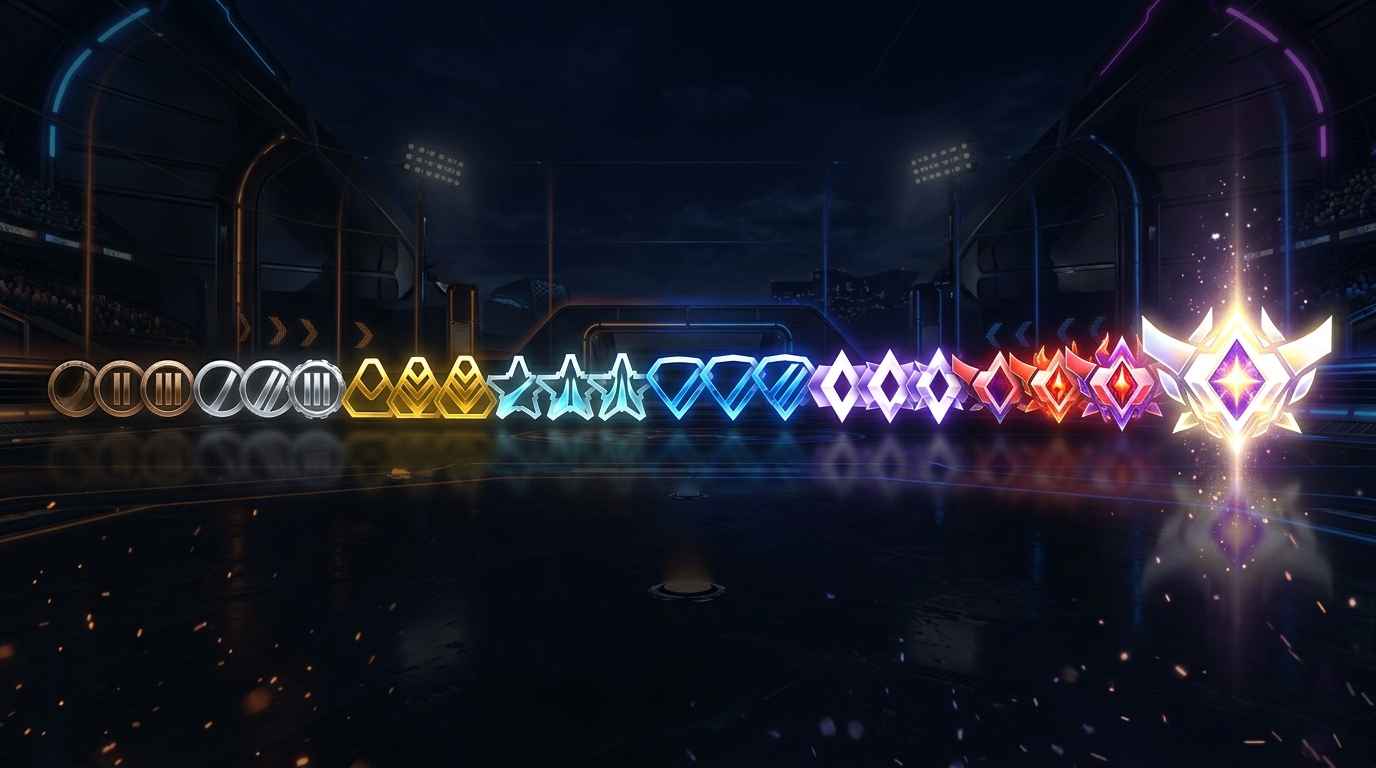
Quick answer: Rocket League has 22 competitive ranks across 8 tiers, from Bronze to Supersonic Legend. Your visible rank badge is just a label for your MMR (Matchmaking Rating), which since Season 22 is now visible in-game. In the current 2026 rank distribution, Gold and Platinum hold roughly half of all players (the most common ranks), Diamond puts you in the top 30%, Champion the top 15%, Grand Champion the top 5%, and Supersonic Legend is the elite top 0.05%. Each playlist (1v1, 2v2, 3v3) has its own separate MMR and 10 placement matches, and there is no rank decay.
Want to push past whatever rank is holding you back right now? Our Rocket League boosting service has pro players ready to move your MMR, fast, safe, and guaranteed for your target rank.
Related Guides:
- Best Rocket League Cars 2026: Hitboxes & Pro Picks
- Best Rocket League Camera & Controller Settings 2026
All Rocket League Ranks in Order (2026)
There are 22 competitive ranks across 8 tiers in Rocket League. Every rank except Supersonic Legend is divided into three tiers (I, II, III), and every tier has four divisions (I through IV). Division IV is the top of each tier, clear it and you promote; drop out of Division I and you demote. In total that’s 84 separate divisions before SSL, which sits alone at the top with no divisions. Here are all the ranks in order with their approximate MMR:
| Rank | Tiers | Approximate MMR (3v3) | Division Structure |
|---|---|---|---|
| Bronze | I, II, III | 0 to 255 | 4 divisions per tier |
| Silver | I, II, III | 256 to 511 | 4 divisions per tier |
| Gold | I, II, III | 512 to 767 | 4 divisions per tier |
| Platinum | I, II, III | 768 to 1023 | 4 divisions per tier |
| Diamond | I, II, III | 1024 to 1279 | 4 divisions per tier |
| Champion | I, II, III | 1280 to 1535 | 4 divisions per tier |
| Grand Champion | I, II, III | 1536 to 1799 | 4 divisions per tier |
| Supersonic Legend | No tiers | 1800+ | No divisions, single rank |
A quick note on these MMR numbers: they’re approximate baselines for 3v3 Standard. Thresholds shift slightly between playlists and Psyonix adjusts them between seasons. 1v1 thresholds are typically 50 to 100 MMR lower than 2v2 for the same rank, while 3v3 thresholds tend to be 20 to 40 MMR higher. The values above give you a reliable frame of reference for Standard play specifically.
Rocket League Rank Distribution & Percentages (2026)
Here’s where most players actually want to know they stand: the rank distribution. What percentage of players sit in each rank, and what’s the most common rank? The distribution follows a bell curve centered on Gold and Platinum. Here’s the current breakdown for 3v3 Standard, the most populated playlist:
| Rank | % of Players (3v3) | Percentile |
|---|---|---|
| Bronze I to III | ~4% | Bottom 4% |
| Silver I to III | ~10% | Bottom 14% |
| Gold I to III | ~24% | Most common rank |
| Platinum I to III | ~25% | Just above average |
| Diamond I to III | ~20% | Top 30% |
| Champion I to III | ~10% | Top 15% |
| Grand Champion I to III | ~5% | Top 5% |
| Supersonic Legend | ~0.05% | Top 0.05% |
Reading the distribution: Gold and Platinum together hold roughly 49% of all ranked players, so if you’re wondering what the most common rank is, it’s Gold, with the average player sitting around Gold III to low Platinum. If you’re in Diamond, you’re already in the top 30% of the entire Rocket League playerbase. Champion is the top 15%, Grand Champion is the top 5%, and Supersonic Legend represents the elite top 0.05%, fewer than one in two thousand players out of millions. That’s not a typo; SSL is genuinely rare.


These percentages shift slightly between playlists. Extra Modes like Rumble, Dropshot, Hoops, and Snow Day have their own distributions, generally shifted lower than standard playlists because fewer players grind them, so the pool is more casual on average. But for 3v3 Standard, the numbers above are the reliable current picture.
How MMR Works in Rocket League
MMR stands for Matchmaking Rating, and it’s the number that actually determines your rank. Your rank badge is just a label for the MMR range you’re currently sitting in. Win a match and your MMR goes up; lose one and it goes down. Simple in concept, more nuanced in practice.
Despite what a lot of players say, Rocket League does not use ELO. It uses a system closer to Glicko, which accounts for the relative MMR of both teams, not just whether you won or lost. A typical win in a balanced match where both teams have similar average MMR grants around +8 to +12 MMR. Defeating players with significantly higher MMR can reward up to +20, while beating lower-MMR opponents might only net +4 to +6. The same logic applies to losses: drop a match against a team with lower MMR and you lose more than if you fell to a higher-ranked team. The system is always trying to find your true skill level as efficiently as possible.
Visible MMR in Season 22 (The Big 2026 Update)
This is the most significant quality-of-life change to Rocket League’s ranking system in years. Since Season 22, your MMR is displayed in-game in the playlist menu. You no longer need Rocket League Tracker or any third-party app to see your actual MMR number, it’s right there in the competitive lobby. For players who want more detail like exact match history, win/loss streaks, and teammate performance, Rocket League Tracker at tracker.gg remains the most comprehensive third-party tool, but for simply knowing your MMR and checking your rank, the in-game display now handles it.
Placement Matches and Seasonal Resets
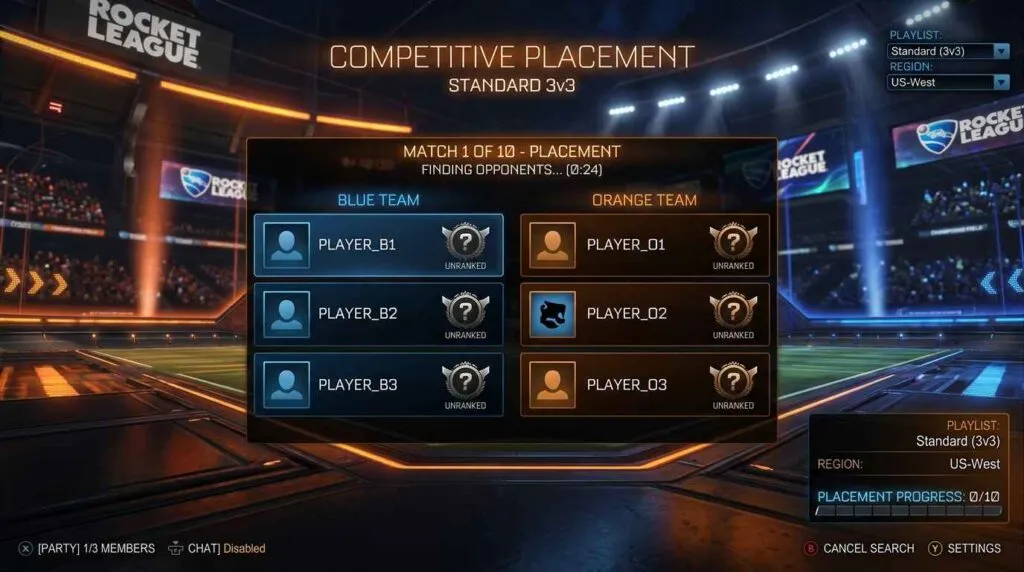
Every Rocket League season starts with a soft MMR reset and 10 placement matches to re-establish your visible rank. These two things are related but often confused.
The soft reset compresses your MMR slightly toward the average rather than wiping it entirely. If you ended last season at Grand Champion, your MMR drops somewhat at the reset, but you still start well above the player who ended in Gold. Higher ranks see greater compression, so expect a bigger MMR drop if you ended in GC or SSL. It keeps the ladder healthy by preventing rank inflation from stacking season over season.
Placement matches are how you get your visible rank badge back after a reset. Play 10 matches in any competitive playlist; your underlying MMR already exists from the soft reset, and your placement results calibrate where the system places your visible rank on that scale. Win more placements and you’ll get a higher initial rank display. Lose most and you’ll start lower, even if your MMR is the same underneath.
One important thing: each playlist has its own MMR and requires its own placement matches. 1v1, 2v2, and 3v3 are tracked completely independently. If you want a visible rank in all three, that’s 30 placement matches total, 10 per playlist.
Competitive Playlists and Extra Modes
Rocket League has three main competitive playlists, each with its own independent MMR and rank track:
- 1v1 Duel, solo, every mistake is yours alone. Ranks typically run 50 to 100 MMR lower than your team-mode equivalents. Mentally the hardest playlist.
- 2v2 Doubles, the fast-paced two-player format. Many players find this their strongest playlist because the smaller team size allows more individual impact.
- 3v3 Standard, the main competitive format. Requires rotation discipline, team coordination, and the most well-rounded skill set of any playlist.
Beyond the three main playlists, Rocket League also has four Extra Modes with their own ranking systems: Rumble (3v3 with random power-ups), Dropshot (break through the floor to score), Hoops (2v2 basketball), and Snow Day (3v3 with a puck). Each Extra Mode requires its own 10 placement matches, and these ranks and MMRs are completely separate from your competitive playlists, grinding Rumble won’t affect your 3v3 Standard rank at all.
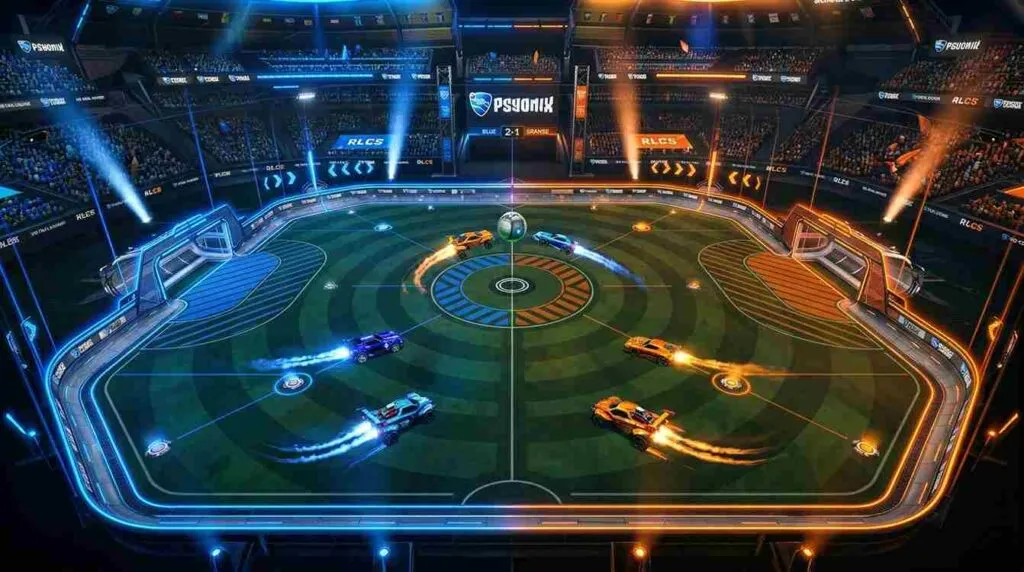
One thing worth knowing: most players rank noticeably lower in 1v1 than in team modes. In Duel, every mistake directly leads to scoring opportunities with no teammate to cover you, so don’t be discouraged if your 1v1 rank seems low compared to your 2v2 or 3v3. This is almost universal.
Party and Queue Restrictions
You can’t queue with just anyone in competitive. Rocket League has rank range restrictions to prevent high-ranked players from carrying low-ranked friends through lobbies. In 3v3 Standard, two-player stacks must be within a certain MMR range of each other, and that range tightens as ranks get higher, a Diamond and a Bronze simply cannot queue together in a two-stack. Party matchmaking weights toward the highest-ranked player at higher tiers, so expect tougher lobbies if you’re the lower-ranked friend.
A few practical things to know:
- Full three-player parties in 3v3 have less restrictive range limits, but the lobby difficulty is set by the highest-ranked player’s MMR
- Four-player parties are not allowed, you need a full team or play solo/duo in 3v3
- 1v1 has no party play, it’s always solo
- 2v2 requires both players to be within a reasonable MMR range
- The game tells you immediately if you can’t queue with someone due to rank difference
No Rank Decay in Rocket League
Rocket League does not have rank decay. Your rank only changes based on match outcomes, wins and losses. If you stop playing for a month, your rank badge stays exactly where you left it; you won’t log back in to find yourself demoted. There’s one catch: your MMR under that badge does shift over time through seasonal soft resets. But in terms of day-to-day inactivity, you’re completely safe. Play when you want, take breaks, come back, the rank waits for you.
Seasonal Rewards in Rocket League 2026
At the end of each competitive season, Psyonix rewards players with cosmetics based on the highest rank they reached during that season, not their ending rank. So even if you hit Diamond III once before dropping back to Platinum, you’ll receive the Diamond reward tier. Current seasonal rewards include:
- Wheels, rank-specific animated wheel designs
- Car Decals, exclusive body decals for the season’s theme
- Boosts, animated boost trails
- Trails, goal explosion and car trail cosmetics
- Titles, Champion and above unlock exclusive player titles
The higher your peak rank, the more elaborate the reward. Supersonic Legend rewards are genuinely rare, and other players will notice. Rewards also differ by playlist, reaching Grand Champion in 3v3 earns a different reward than in 2v2 or 1v1, so if you want rewards from multiple playlists, you need to hit the thresholds in each independently.
What Each Rank Actually Means
Numbers and percentages are useful, but it’s worth knowing what separates each rank in terms of actual gameplay skill.
| Rank | What Players Typically Do | What’s Holding Them Back |
|---|---|---|
| Bronze | Learning basic mechanics, ball chasing is common | No boost management, limited aerial awareness |
| Silver | Consistent ground shots, some aerial attempts | Rotation issues, frequent double commits |
| Gold | Basic rotation forming, more consistent shots | Over-committing, poor positioning after shots |
| Platinum | Air dribbles attempted, game sense developing | Mechanical consistency, rotation under pressure |
| Diamond | Flip resets, consistent aerials, shadow defense | High-speed decision making, advanced rotation reads |
| Champion | Mechanical execution approaching pro consistency | Game sense in high-pressure situations |
| Grand Champion | All mechanics reliable, reading opponents at speed | The marginal differences separating GC from SSL |
| Supersonic Legend | Professional or near-professional in all aspects | Nothing systematic, variance is the only ceiling |
How to Climb Rank in Rocket League
The ranking system is an accurate mirror of your skill over time, which means the only reliable way to climb is to genuinely get better. That said, some habits accelerate improvement dramatically:
Play one playlist until you hit a wall. Most players spread themselves across 1v1, 2v2, 3v3, and extra modes at once, splitting practice across five skill sets. Pick 3v3 Standard or 2v2 Doubles, whichever you enjoy, and grind it specifically. Focused repetition compounds faster than playlist hopping.
Your rotation matters more than your mechanics. Below Diamond, rank is almost never lost to mechanical failure. It’s lost to two players committing to the same ball, leaving the net empty, or chasing a lost ball into a corner. Shadow defense, third-man positioning, and waiting your turn wins more games than any mechanical trick at Gold and Platinum.
Watch your replays. Not to feel bad, but to identify the one mistake per game that costs you most. Almost every loss at low and mid rank has one catastrophic moment. Find the pattern and you know what to train.
Use free play for mechanics, not ranked. Learning to aerial in ranked is expensive; every failed attempt is a free chance for the other team. Get your aerials, air rolls, and power shots functional in free play first, then casual, then ranked.
Play your placements seriously. Your placement results calibrate where your visible rank starts. Playing your best 10 matches at the start of each season sets your rank display higher, and climbing from above average feels better than grinding back from an artificially low start.
Don’t play when you’re tilting. MMR isn’t affected by whether you play well, only whether you win. Playing frustrated or exhausted makes losses more likely and compounds them psychologically. Log off after three consecutive losses and come back fresh.
Conclusion
Rocket League’s ranking system in 2026 is more transparent than ever. Here’s the summary:
- 22 ranks from Bronze I to Supersonic Legend, across 8 tiers with 84 total divisions
- MMR is the real rank, your badge is just a label for your current MMR range
- Season 22 update: MMR is now visible in-game, no tracker required
- Rank distribution: Gold and Platinum hold ~49% of players; Gold is the most common rank
- Diamond is top 30%, Champion top 15%, GC top 5%, SSL the top 0.05%
- 10 placement matches per playlist, separate for 1v1, 2v2, and 3v3
- No rank decay, inactivity doesn’t cost you your rank
Now that you know exactly where you sit in the distribution and how MMR moves, the only thing left is climbing. Focus one playlist, fix your rotation, and play your placements seriously, and your rank will follow.
Frequently Asked Questions
How many ranks are in Rocket League in 2026?
Rocket League has 22 competitive ranks in 2026, spanning 8 tiers from Bronze to Supersonic Legend. Each rank except Supersonic Legend is divided into 3 tiers (I, II, III), and each tier has 4 divisions (I to IV), totalling 84 divisions before SSL, which sits alone at the top.
What is the most common rank in Rocket League?
The most common rank in Rocket League is Gold, with the average player sitting around Gold III to low Platinum in 3v3 Standard. Gold and Platinum together hold roughly 49% of all ranked players. The rank distribution follows a bell curve, so the middle ranks (Gold and Platinum) are by far the most populated.
What percentage of Rocket League players are each rank?
In 3v3 Standard, the approximate rank distribution is Bronze ~4%, Silver ~10%, Gold ~24%, Platinum ~25%, Diamond ~20%, Champion ~10%, Grand Champion ~5%, and Supersonic Legend ~0.05%. This means Diamond puts you in the top 30% of players, Champion the top 15%, Grand Champion the top 5%, and SSL the elite top 0.05%.
What is MMR in Rocket League?
MMR stands for Matchmaking Rating, the hidden numerical score that determines your actual rank and who you’re matched against. Win a match and your MMR rises; lose and it drops, with the amount based on the relative MMR of both teams. Since Season 22, your MMR is visible directly in the competitive lobby menu without needing a third-party tracker.
What percentage of players are Grand Champion in Rocket League?
Roughly 5% of players reach Grand Champion across the three Grand Champion tiers in 3v3 Standard, placing GC players in the top 5% of the entire playerbase. Supersonic Legend, the rank above it, is far rarer at approximately 0.05%, or fewer than one in two thousand players.
How rare is Supersonic Legend in Rocket League?
Supersonic Legend is extremely rare, representing approximately the top 0.05% of players, fewer than one in two thousand out of millions of ranked players. It’s the only rank with no tiers or divisions and requires roughly 1800+ MMR in 3v3. SSL seasonal rewards are correspondingly rare and visually distinct.
Does Rocket League have rank decay in 2026?
No. Rocket League does not have rank decay. Your rank only changes through winning or losing matches, so taking a break will not cause your rank to drop. The only rank adjustment that happens without playing is the soft MMR reset at the start of each new competitive season.
How do placement matches work in Rocket League?
At the start of each season, you play 10 placement matches per competitive playlist to receive your visible rank. Your underlying MMR carries over from the previous season with a soft compression adjustment, and your placement results calibrate where your visible rank starts. Each playlist, 1v1, 2v2, and 3v3, requires its own 10 placement matches independently.