Not long ago, CS skins were simply a way to change the appearance of weapons. Today, skins are a fully-fledged financial market, where the value of skins can exceed that of the actual items. It has its booms and busts, its collectors and lucky players. Thousands of dollars can disappear overnight simply because Valve released a patch changing the rules for obtaining rare items.
In this reality, the question of “sell or hold” is no longer meaningless. It’s a choice between preserving your money and hoping for another price hike for a skin. And the answer depends not only on luck, but on an understanding of how the economy works.
When Is the Best Time to Sell CS2 Skins?
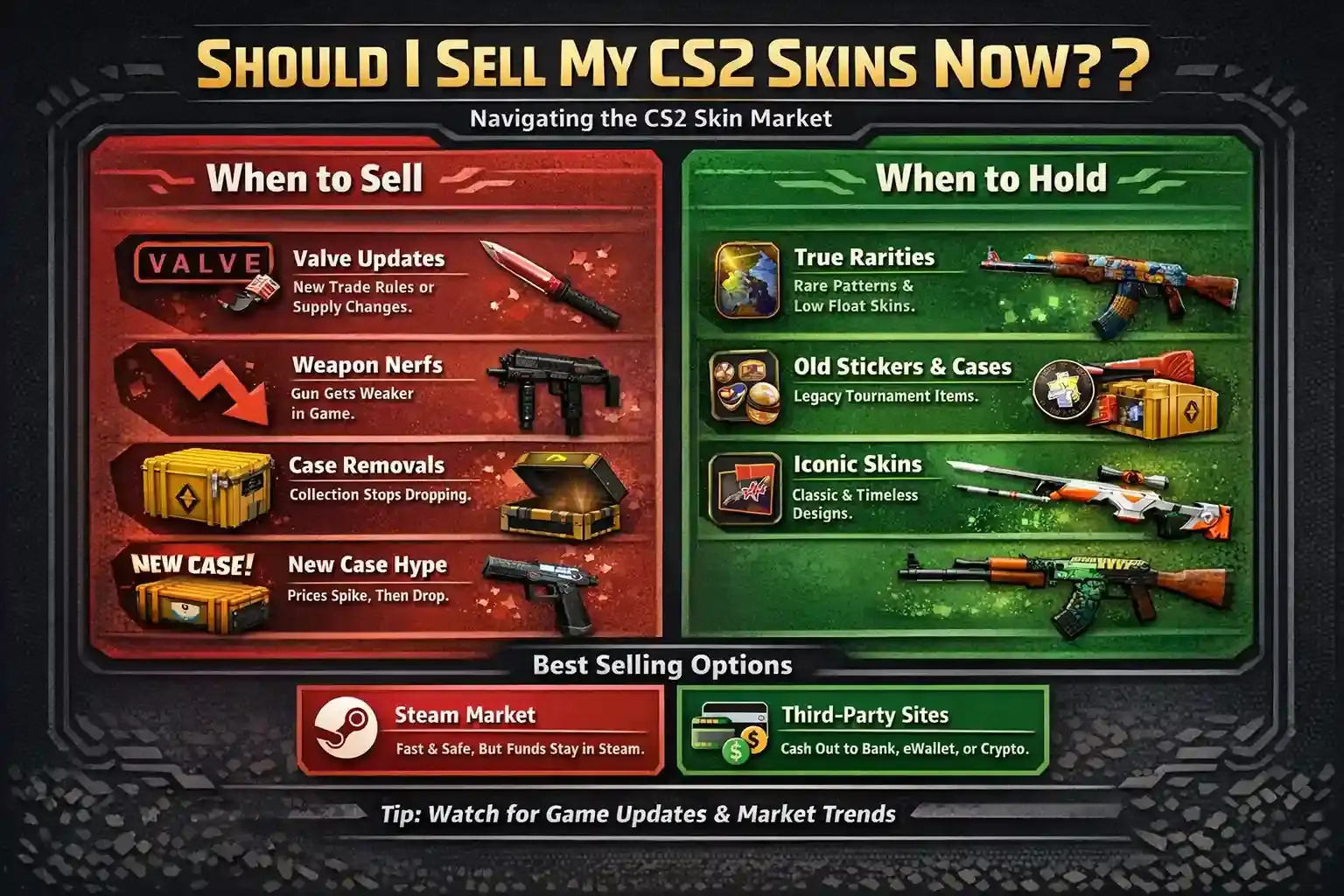
When discussing the best time to sell skins, it’s worth listing the objective reasons why holding on to skins becomes unprofitable:
- The main risk to skin value is Valve’s actions. The trade-up contract update in October 2025 is a perfect example. Valve allowed five Cover skins to be exchanged for knives and gloves, which immediately collapsed the premium skin market. If the developers change the rules of the game to increase the supply of rare in-game items, this is a signal to sell.
- Game balance changes. When a patch makes a weapon more powerful, demand for its skins soars. The most recent example is the MP7 buff in early 2026, which significantly increased the price of some skins for this assault rifle. However, if a weapon is nerfed, the price of its skins can also drop. Here, it’s worth keeping an eye not only on Valve’s news but also on the professional scene. If pro players start using a new weapon en masse, the price of its skins will likely rise, making it a good time to sell.
- Removing skins from cases. If a collection or case stops dropping, the price of skins from it usually climbs. This is a classic scenario. But it’s important not to miss the moment when prices stabilize.
- Hype around a new case. In the first few days after a new case’s release, prices for its skins can be sky-high. Then they almost always drop. Selling quickly is often a better decision than holding on and hoping for a miracle.
When Is the Wrong Time to Sell CS2 Skins?
There are also times when you shouldn’t be overly concerned about skin depreciation. These are cases where a skin can be kept in your inventory for years:
- True rarity is forever. There are skins that aren’t affected by balance patches. These are skins with unique patterns (for example, Case Hardened’s Blue Gem), with a very low float value, or with rare stickers from old tournaments. Their supply on the market is finite, and demand from collectors will only grow. These are skins worth thousands of dollars that can be passed down through generations.
- Tournament stickers and cases from past years, capsules with autographs from legendary players who have since left the pro scene, or cases that haven’t dropped in a long time—these are digital assets whose value depends solely on the historical memory of the community. As long as people play CS2, these skins hold their value.
- An aesthetic that has become iconic. Some skins just look good, and that’s enough. The meta doesn’t matter. For example, AWP | Asiimov or AK-47 | Fire Serpent. Buyers will always look for clean versions of these skins with good floatation. If you have one, time is on your side.
What’s the Best Way to Sell a CS2 Skin?
When it comes to selling skins, the first question is always the same: where is the best place to sell a skin? The easiest option is Steam. It’s fast, secure, and the money is deposited into your account instantly. But there’s a catch: you can’t withdraw the money; it stays in the Steam system. If you plan to buy other skins or games, for example, this is a great option. But if you need real-world money, you need other options.
If you want to sell skins for money, you need third-party platforms. These can be platforms that specialize exclusively in selling or trading skins, or they can be platforms for opening cases with the market. On these platforms, you sell skins and receive money, which can then be withdrawn to a bank card, e-wallet, or crypto wallet. The downsides include fees and transfer wait times.
Conclusion
The skin market is full of unpredictability. There are no guarantees, but there is logic. Most market changes can be predicted by monitoring in-game changes and player sentiment. In any case, CS2 is full of skins suitable for long-term storage, and their prices rise slowly but steadily. It’s not about quick money, but about patience.