


Fracture is hands-down the most unique map ever added to Valorant. It throws out the rulebook on attacker and defender positioning, gives attackers two spawns connected by ziplines, and forces both sides to constantly rotate. Some players love it. Others dodge instantly.
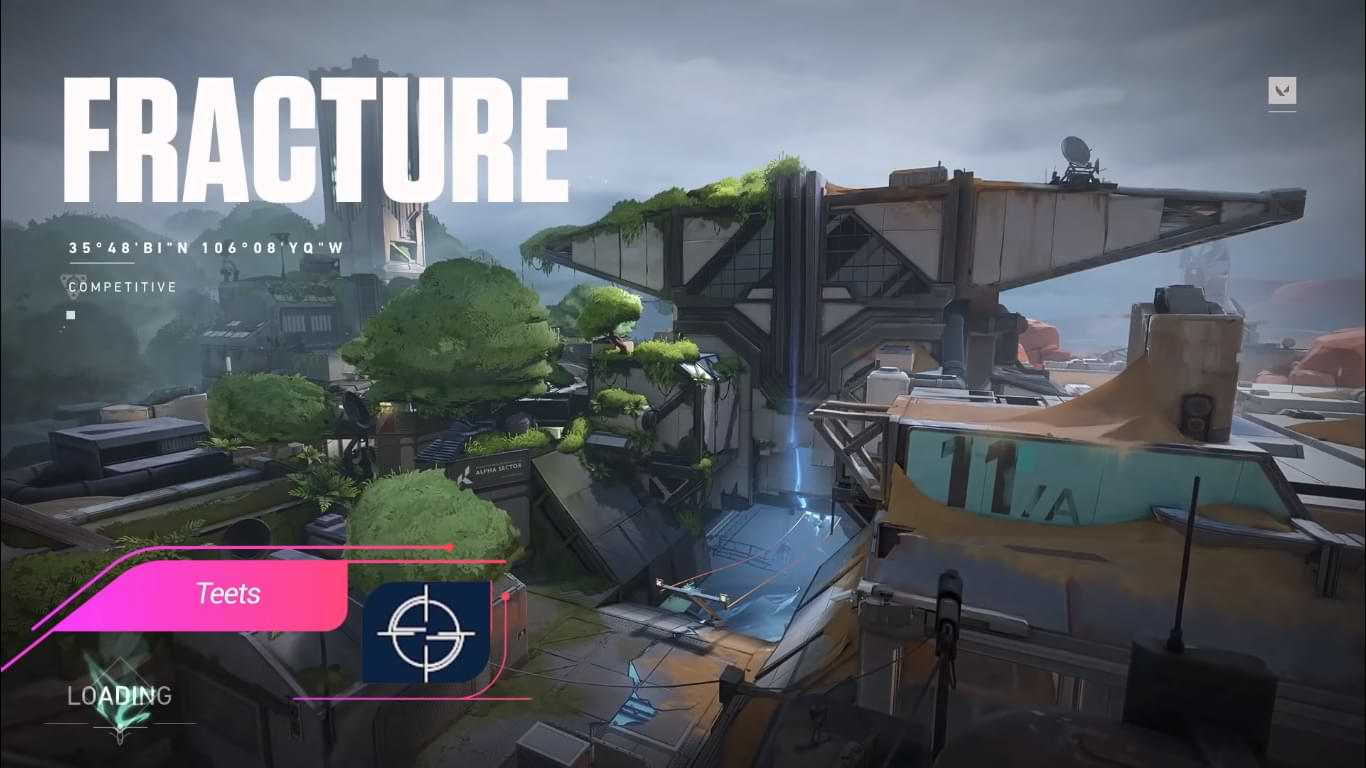
Whichever camp you’re in, learning Fracture turns it into a pocket pick that wins you rounds in solo queue. This guide breaks down the layout, the best agents per role, attack and defense plans for both sites, and every callout you need to communicate effectively with your team.
Want to climb faster while mastering tricky maps like Fracture? Check out our Valorant Boosting Services for fast, secure rank progression. Pick your current and target rank, get matched with an Immortal-tier booster, and skip the elo grind.
Related Guides:
- Best Team Comps for Every Valorant Map
- How to Climb Ranked in Valorant
- Ascent Map Valorant Guide
- Valorant Lotus Map Guide
Fracture Map Overview
Fracture has the strangest layout in Valorant. Defenders spawn in the middle of the map, while attackers get two separate spawns on either side. Two single-direction ziplines connect the attacker spawns, making cross-map rotations almost instant.
The ziplines aren’t just rotation tools. They also act as escape routes when defenders push aggressively. On top of that, Fracture has four ultimate orbs instead of the usual two — two attacker-favored and two defender-favored.
The combined layout makes Fracture attacker-sided at most ranks. Defenders struggle to contest orbs without spreading thin, while attackers can grab orbs safely and pressure both sites at the same time. Understanding that imbalance is the first step to playing the map well.
Best Agents for Fracture
Pro teams experiment with comps every week on Fracture. There’s no single “perfect” lineup, but certain agents consistently outperform others across every role.
Duelists
Neon and Raze dominate the duelist slot on Fracture thanks to their site-clearing utility. The sites are compact, which means Raze ultimates and Neon walls cover huge portions of the bomb area. Teams like Optic have used both with massive success.
Jett still has a place if your team wants Operator pressure, but losing her means losing the OP threat — which is why many teams pair Neon or Raze with a Chamber instead.
Sentinels
Cypher is the on-site lockdown pick. His two tripwires watch both sides of B Site and his camera locks down entire angles. Best when paired with Viper, Sage, or Astra for layered defense.
Chamber is the aggressive pick. He gives map-wide intel through trips, an Operator that can swing fights, and a teleport that turns first-blood plays into retake opportunities. Use Chamber if your team plays off-site retakes.
Initiators
Breach is the king of Fracture. His stun covers half of both sites, his Fault Line stuns through walls, and his Rolling Thunder ultimate ends rounds against on-site defenders. Pick Breach on almost every Fracture comp.
KAY/O brings suppression and flashes that disable defender utility mid-fight. His knife covers B Site and most of A Site, and his molly denies defender positioning. Great secondary initiator pairing with Breach.
Controllers
Brimstone is the most-picked Controller on Fracture. His Stim Beacon accelerates site takes, his molly holds post-plants, and his ultimate clears tower or dish on demand.
Viper and Astra are on-site Controller picks. Viper’s wall and mollies deny site execution, while Astra’s stars combo perfectly with Breach and Raze utility for one-tap setups.
Defending A Site on Fracture
A Site is the smaller of the two bombsites and the easier one to retake — but the harder one to hold from a coordinated split.
On-site defense: If you’re playing Viper or Cypher, anchor the site and burn utility on enemy executes. The goal isn’t survival — it’s trading at least two enemies before going down.
Off-site defense: Most high-level teams hold A Main instead of dish. Pop flashes from the door, fight from the bench, and retreat to retake if pressure becomes too much. Chamber mains love teleporting from dish for opening picks before pulling back.
Retaking A: Smoke off Dish to remove dish players from the round. Stun A Main, throw mollies onto the bomb, and send two players through the opening door to pinch defenders.
Defending B Site on Fracture
B Site is the bigger of the two and the harder one to defend. The split potential through Arcade and B Main makes anchoring B alone almost impossible.
On-site defense: Lock all your utility toward B Main and have a teammate watch Arcade from tower or canteen. Multiple angles need clearing when attackers reach the top staircase.
Tower control: Tower is the most important position on B defense. Hold it as long as enemy ultimates allow. If they have Breach or Brimstone ult ready, pre-rotate before they clear you out.
Retaking B: Deny the plant first with mollies, stuns, or Astra pulls. Smoke B Main or Arcade after the bomb goes down to break crossfires. Clear the back cubby with utility, then push tower last. Always fight tower control before defusing.
Attacking A Site on Fracture
Attacking on Fracture is a breeze if you pressure both sides every round. The key is splitting your team through both attacker spawns to force defender rotations.
Standard A execute: Send two players to dish, three to A Main. Hold the door for defender aggression, then pinch the site from both angles. Smoke CT, Sand, and Heaven for clean entries.
Door execute: If you don’t have site-clearing utility, push A Main through the door to Sand. Smoke only CT and Heaven so your team can collapse from three angles.
Post-plant A: Plant in the open corner near A Main for spam coverage, or plant in the back corner if dish is too dangerous. The back corner is ideal — your team plays A Main and spams smoke-defusers while dropping easy mollies on the bomb.
Attacking B Site on Fracture
B Site demands tower control before you commit. Without it, the plant fails and the retake destroys you.
Tower clear: Use Brimstone or Breach ultimates to clear tower defenders. Apply pressure from Arcade while pushing B Main simultaneously.
Site execute: Split through Arcade and B Main. Smoke CT and Canteen to block rotations. Never smoke tower — it divides your forces and helps the defenders.
Post-plant B: Establish crossfires between B Main and Arcade. Incoming defenders face a 50/50 angle decision. Use the tunnel to rotate between positions without exposing yourself to crossfire. Use flashes or mollies before swinging tower for any defuse defense.
Map Control Tips for Fracture
Three positions decide every Fracture round. Master these and your win rate skyrockets.
- Rope control: Crucial for A site attacks. Rope control opens A Site rotations and forces defenders into bad retake angles through Drop or spawn.
- Tower control: Essential for both B site attacks and defense. Strong entrance, strong post-plant, and a height advantage over the entire site.
- Tunnel control: Lets you grab two ultimate orbs per round with minimal risk. Send a lurk to grab the A-side orb after taking the B-side one. Killjoy ultimate placed in the tunnel covers the entire site.
If you’re playing solo queue, ping these positions on the map before round start. Half the battle on Fracture is your team knowing where to look.
Fracture Callouts
Communication wins Fracture games. Here are the essential callouts for both bombsites.
A Site Callouts
- A Main: Primary attacker entry to A Site.
- Stairs: Connect bottom site to top site.
- A Short: Leads to bombsite, connects to defender spawn via rope.
- A Link: Shortest defender rotation to A Site.
- Heaven: Overhead spot with vision on A Main, A Short, and the site.
- Top Site: Plant spot with vision of A Main, A Drop, A Link, and A Long.
- Bottom Site: Lower plant spot with pillar cover, harder to reposition from.
B Site Callouts
- B Main: Primary attacker entry to B, contains an ultimate orb.
- B Long: Main path leading to B Site and plant zone.
- Double Box: Cover spot watching B Long entrance.
- Generator: Retake spot watching B Long and the site, connects to B Link.
- B Canteen: Defender position with best angle on B Long entries.
- Bench: Attacker-side position with view of Arcade, Underpass, and Tower.
- Underpass: Connects both sides of B bombsite for safe rotations.
- Arcade: Forward defense position with cover and vision of Bench and Tower.
- Tower: High-ground peek and reposition spot, vision over Bench.
Fracture Map at a Glance
| Category | Detail |
|---|---|
| Released | September 8, 2021 (Episode 3 Act 2) |
| Location | Everett-Linde Facility, Diablo Canyon, New Mexico |
| Attacker Spawns | 2 (connected by ziplines) |
| Ultimate Orbs | 4 (2 attacker-sided, 2 defender-sided) |
| Best Duelists | Neon, Raze, Jett |
| Best Sentinels | Cypher, Chamber |
| Best Initiators | Breach, KAY/O |
| Best Controllers | Brimstone, Viper, Astra |
| Map Bias | Slightly attacker-sided |
Conclusion
Fracture is a wild map that punishes uncoordinated teams and rewards smart utility usage. Use this checklist to start dominating:
- For Attackers: Always pressure both spawns. Take tower or rope control before committing to a site.
- For Defenders: Play off-site if possible. Sites are too compact to hold from a coordinated split.
- For Solo Queue: Pick Breach. Stuns through walls and a site-wiping ultimate carry hard.
- For Team Players: Lock in Brimstone for execute speed and post-plant utility.
- For Communication: Memorize the callouts and ping early. Map awareness wins more rounds than aim does on Fracture.
Rope control, tower control, and tunnel control are the three pillars of every successful Fracture match. Lock those down and the map opens up for your team.
FAQ
Where is Fracture located in Valorant?
Fracture is set inside the Everett-Linde Facility near Diablo Canyon, New Mexico. The map’s lore involves a research lab where a fracture in the planet’s surface has created the unique split-attacker spawn layout.
When did Fracture come out in Valorant?
Fracture was released on September 8, 2021, during Episode 3 Act 2 of Valorant. It was the first map added to the game after Icebox and introduced the dual-spawn attacker mechanic.
Is Fracture in the current Valorant map rotation?
Fracture was removed from the active competitive map rotation after the 2023 VCT season ended, but Riot has rotated it back into ranked queue at various points since. Check the current Valorant patch notes to see whether it is in the live map pool.
What is the best agent for Fracture in Valorant?
Breach is the strongest single agent for Fracture. His stuns cover half of both sites, his Fault Line clears through walls, and his Rolling Thunder ultimate ends rounds against on-site defenders. Almost every competitive Fracture comp includes Breach.