


If your Dota 2 behavior score has dropped, you already know how it feels: worse teammates, longer queues, muted chat, and lobbies that fall apart before the ten-minute mark. The good news is that the score is fully recoverable — but only if you treat it like a short reputation rebuild rather than hunting for a one-game trick. This 2026 guide breaks down exactly what behavior score is, the real tier thresholds (which most guides get wrong), what actually raises and lowers it, and a clean-game plan you can run over your next update cycle to climb back to the top bracket.
Quick answer: Behavior score updates in batches, not per match. To raise it, play a run of clean games: finish every match, never abandon, mute toxic players instead of arguing, and earn commends. Expect real movement after 10–15 games, and a noticeable lobby-quality shift after 20–30 clean matches.
What Is Behavior Score in Dota 2?
Behavior score is Valve’s numeric reputation system for how reliably you play with others. Think of it as a second, hidden MMR — except instead of measuring skill, it measures conduct. The lower it sits, the more likely you are to be matched with players who feed from the first minute, flame in voice, and bail the moment a game goes sideways. A higher score does the opposite: calmer teammates, faster queues, and functional coordination.
Running alongside it is a separate Communication Score, added in 2023. The two operate independently: behavior score decides who you’re matched with, while communication score tracks the quality of your chat and voice and can mute you mid-match in real time. Your behavior score can look healthy while your communication score quietly gets you silenced — so you need to watch both.
What changed by 2026: The old “Conduct Summary” is now the Player Behavior Summary. The maximum Lifetime Behavior Score is 13,000 (it was 10,000 for years, then rose as the system expanded — ignore older guides that still say 10k or 12k). Valve has also leaned harder into real-time chat analysis, so communication penalties land faster than they used to.
Boost your progress instantly with Dota 2 Boosting and take your matchmaking to the next level. Skip the endless grind, recover your behavior score, escape toxic lobbies, and get back to ranked faster to enjoy everything Dota 2 has to offer without the hassle.
Related Guides:
- Dota 2 Rank Confidence & the Glicko Rating System
- DOTA 2 The International 2026 (TI15)
- Dota 2 Rank Calibration & MMR Guide 2026
Dota 2 Behavior Score Tiers & What Each Unlocks
Your score doesn’t just sit in your profile — each bracket gates real features. Here’s the practical breakdown players report in 2026. Treat the thresholds as close approximations, since Valve tunes them over time and doesn’t publish exact numbers:
| Score range | What it means for you |
|---|---|
| Below 3,000 | Locked out of ranked matchmaking; heavy communication restrictions. The hardest hole to climb out of. |
| 3,000 – 5,000 | Ranked unlocked, but queues are slow and lobbies are rough. Text chat starts returning around here. |
| 5,000 – 8,000 | In-game pausing, map drawing, and voice chat come back as you climb. Games feel noticeably more stable. |
| 8,000 – 10,000 | Full communication access and consistently better teammates. This is the healthy zone most players aim for. |
| 10,000 – 13,000 | Top reputation bracket: fastest queues, the calmest lobbies, and the ability to coach other players. |
The single most important line here is 3,000: drop below it and ranked is gone until you climb back. That’s why recovery matters long before you hit rock bottom.
How to Check Your Behavior Score in Dota 2
Checking takes under a minute, and plenty of players haven’t looked in years:
- Launch Dota 2 and open your Profile.
- Open the Player Behavior Summary tab (formerly “Conduct Summary”).
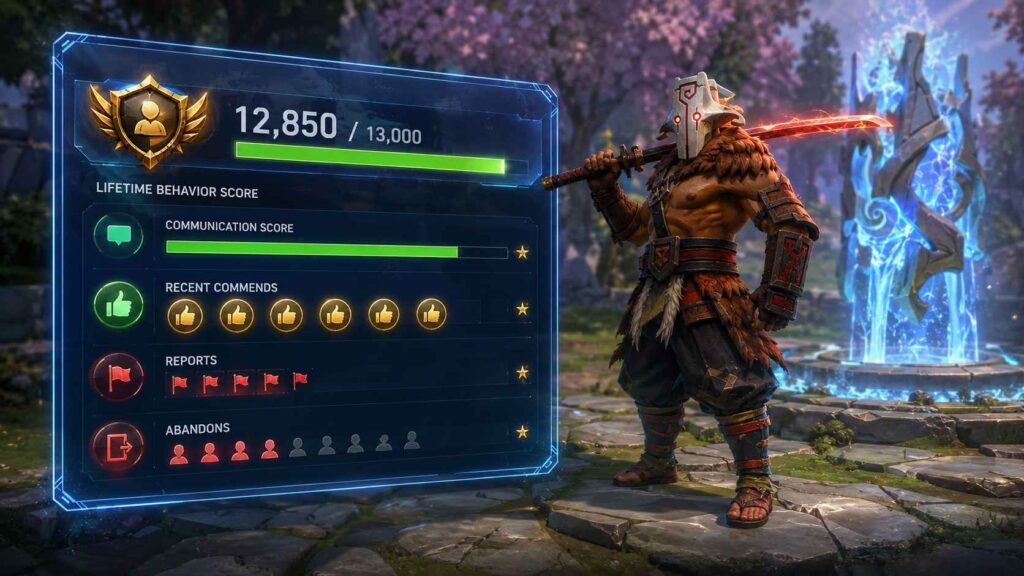
- Read your Lifetime Behavior Score and, next to it, your Communication Score, along with recent reports, abandons, and commends.
One detail that trips people up: the summary recalculates in batches (players typically see updates every 10–15 games, and sooner if you pick up 3+ reports). Checking after a single clean game shows nothing — and that false “it’s not working” feeling is exactly what makes people quit the recovery too early.
What Actually Tanks Your Behavior Score
Each type of bad conduct carries different weight. Knowing the real cost helps you protect weeks of progress:
- Abandoning a match — by far the harshest penalty, roughly 1,000–2,000 points for a single leave. One rage-quit can erase a week of clean games.
- Getting reported — reports from teammates chip away at your score (players estimate a few hundred points per batch of reports). Frequency is what hurts; one stray report rarely matters, but a pattern does.
- Declining the ready check — small but tracked. If you queue, be ready to play.
- Partying with very low-score players — can drag your own matchmaking down.
- Ping spam and chat flooding — not technically an insult, but it reliably earns reports.
The frequency rule: Behavior score responds to patterns, not single incidents. One bad game won’t sink you; a string of them will. That cuts both ways — consistency is also what pulls you back up.



How to Increase Your Behavior Score: A Step-by-Step Plan
These habits only work in combination. One polite game won’t move the needle — you need a consistent pattern across a full update cycle.
1. Finish every game — never abandon
This is the system’s hardest rule and it has no exceptions. Even in a hopeless stomp, even when your team is already at each other’s throats, you stay and finish. A single abandon cancels out the gains from several good matches, so protecting your streak here matters more than any other tip.
2. Farm commends on purpose
Commends are the direct mirror of reports and the fastest legitimate way up. You don’t need heroics — useful wards, a smoke call, defending a teammate from flame, and a calm tone are enough. Opening a match with a neutral, friendly message measurably lowers the chance of an early blow-up. Just don’t beg (“commend me pls”) — it reads as annoying and often gets you reported instead.
3. Mute toxic players instead of firing back
When someone starts flaming, arguing back gives them the reaction they wanted and puts you at risk of a report for joining the conflict. Hit mute and keep playing. The system is good at isolating the actual source of toxicity — as long as you stay out of the fight.
4. Accept your match on time
Declining during the ready check is a tracked penalty. If you queued, be at your desk and ready to lock in.
5. Be mindful of who you party with
Grouping with chronically low-score friends can pull your matchmaking down. You don’t have to stop playing with them — just factor it into your session planning while you’re actively rebuilding.

Can You Raise Behavior Score Fast?
Honestly, there’s no instant switch — the system is cumulative by design and updates every 10–15 games. But you can speed things up, especially from a deep hole:
- Grind the update cycle in Turbo or bot games. If you’re stuck below 3,000, Turbo and bot matches still count toward the batch update but carry far less risk of picking up reports than a toxic ranked lobby. Bank a clean batch there, then return to your normal modes.
- Front-load the fixes. Abandon-free + commend-focused + mute-instead-of-argue, all at once, moves faster than doing one at a time.
- Set realistic expectations. After 20–30 clean matches with no abandons, most players report a clear jump in lobby quality: calmer teammates, real coordination, fewer flame wars.
For more Dota 2 breakdowns, patch coverage, and rank guides across every update, dive into our latest gaming guides and updates.
Common Mistakes That Stall Your Recovery
- Spamming “gg” or “?” at teammates after a death or misplay — it reads as mockery and reliably earns reports.
- Taking the bait in chat — even a measured reply can turn into a report. Mute and move on.
- Only tracking behavior score and ignoring communication score — two systems, two independent penalties.
- Expecting instant results and quitting after one clean game — the summary updates in batches, not per match.
- Playing on tilt — that’s when abandons and meltdowns actually happen. Take a break instead.
Frequently Asked Questions
What is the maximum behavior score in Dota 2?
The maximum Lifetime Behavior Score is 13,000. Older guides still cite 10,000 or 12,000 — those are out of date. Both behavior and communication scores now sit on this expanded scale.
What behavior score do I need to play ranked?
You need at least 3,000 to queue ranked. Below that, ranked is locked entirely. Even just above 3,000, queues are slow and lobbies are rough, so aim well higher for a good experience.
How often does behavior score update?
In batches, not per match — players typically see updates every 10–15 games, and sooner if you receive several reports. Don’t judge progress after a single game.
How much does abandoning cost?
Abandoning is the single harshest penalty, roughly 1,000–2,000 points per leave. It can wipe out the gains from several clean games, so finishing every match is the most important habit.
How long does it take to recover a low behavior score?
There’s no instant fix. Expect real movement after 10–15 clean games and a clear lobby-quality shift after 20–30 matches with no abandons or serious incidents. From a very low score, use Turbo or bot games to bank the cycle safely.
Is behavior score the same as communication score?
No. Behavior score decides who you’re matched with; communication score tracks your chat and voice quality and can mute you in real time. You can have a fine behavior score and still get silenced because of communication score, so watch both.
Does winning games raise behavior score?
Not directly. The score reacts to conduct — commends, reports, abandons — not to wins or losses or your in-game skill. You can lose every game and still climb by playing clean and earning commends.