

Updated 23, 2026 — Tsuru Reef is live. Layout, named locations, and Season 4 phase dates all confirmed and corrected below.
Tsuru Reef isn’t just another map — it’s the biggest one DICE has ever built for Battlefield 6, and it plays unlike anything else in the rotation. Six islands, open ocean, canals and carriers, all connected by boats instead of roads. If you drop in treating it like a normal Conquest map, you’ll spend half the match swimming or stuck on the wrong island watching points flip. Learn how it’s actually laid out first, and it becomes one of the most rewarding maps in the game.
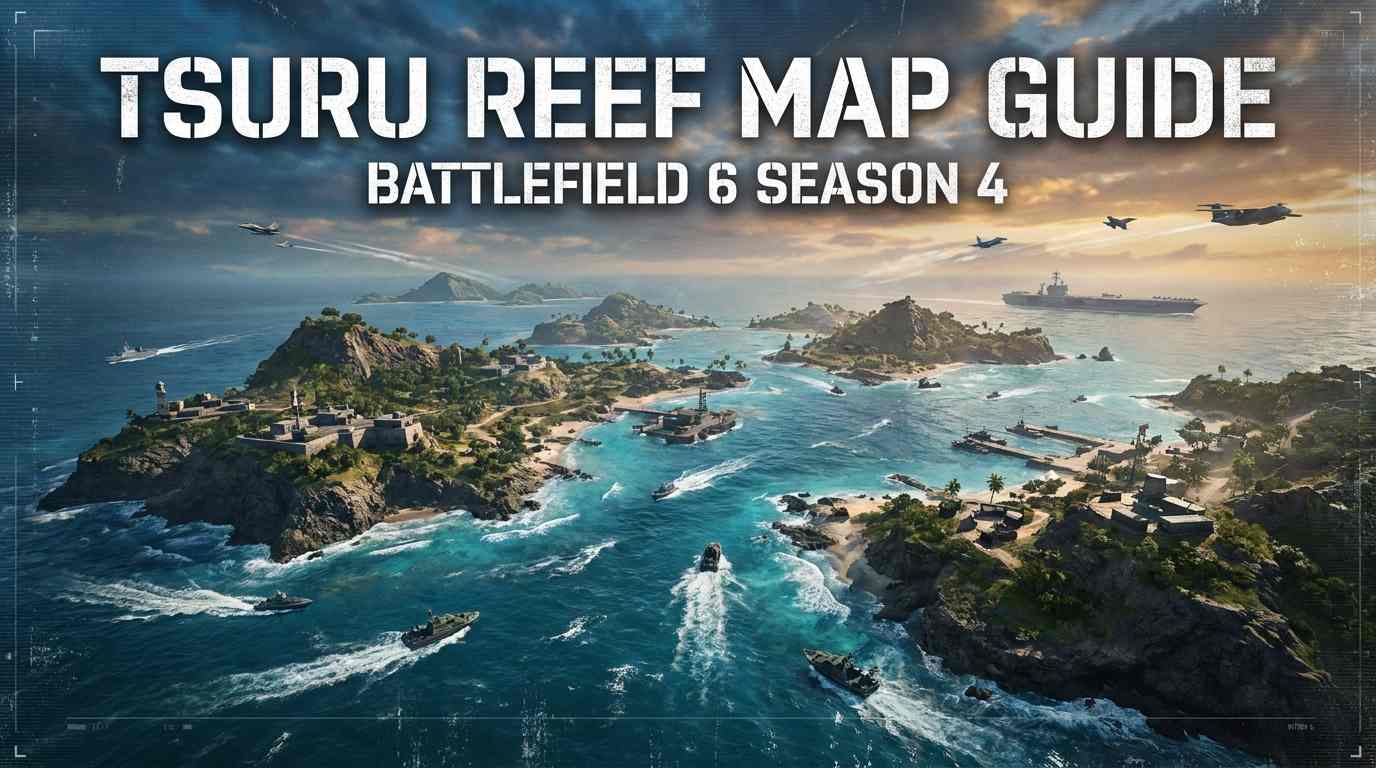
This is the complete Tsuru Reef guide for Season 4: Pacific Front — the real island layout now that the map is live, where the fighting actually concentrates, boat routes and flanking lanes, the best sniper positions, class advice for a naval map, and how to use the dynamic wave system to your advantage. Updated for game update 1.4.1.0.
New naval maps take a dozen matches to click — the players who learn the routes and boat lanes first are the ones farming everyone else right now. Our Battlefield 6 boosting and coaching gets your objective rotations, vehicle tactics, and loadouts dialed for Tsuru Reef so you stop losing matches to map knowledge.
Related Guides:
- Battlefield 6 Season 4 — Naval Warfare & Everything New
- Battlefield 6 Weapons Tier List 2026 — Complete Meta Guide
- Battlefield 6 Vehicle Guide — Tanks, Aircraft & Combat Tips
What Is Tsuru Reef?
Tsuru Reef is the flagship map of Battlefield 6 Season 4: Pacific Front, live since July 21, 2026 via game update 1.4.1.0, with content unlocking at 12:00 UTC. It’s officially the largest map in Battlefield 6 history — bigger than Railway to Golmud, which was already nearly four times the size of Mirak Valley.
The setting is more specific than the pre-launch teasers suggested: a NATO installation under joint control with Japan’s Self-Defense Forces, under siege from Pax Armata. The archipelago packs in a luxury resort, a dormant volcano, steep cliffs, and an old war bunker, all connected by wide ocean lanes. Players immediately clocked the resort as a deliberate nod to Battlefield 4’s Hainan Resort — and it plays like it.
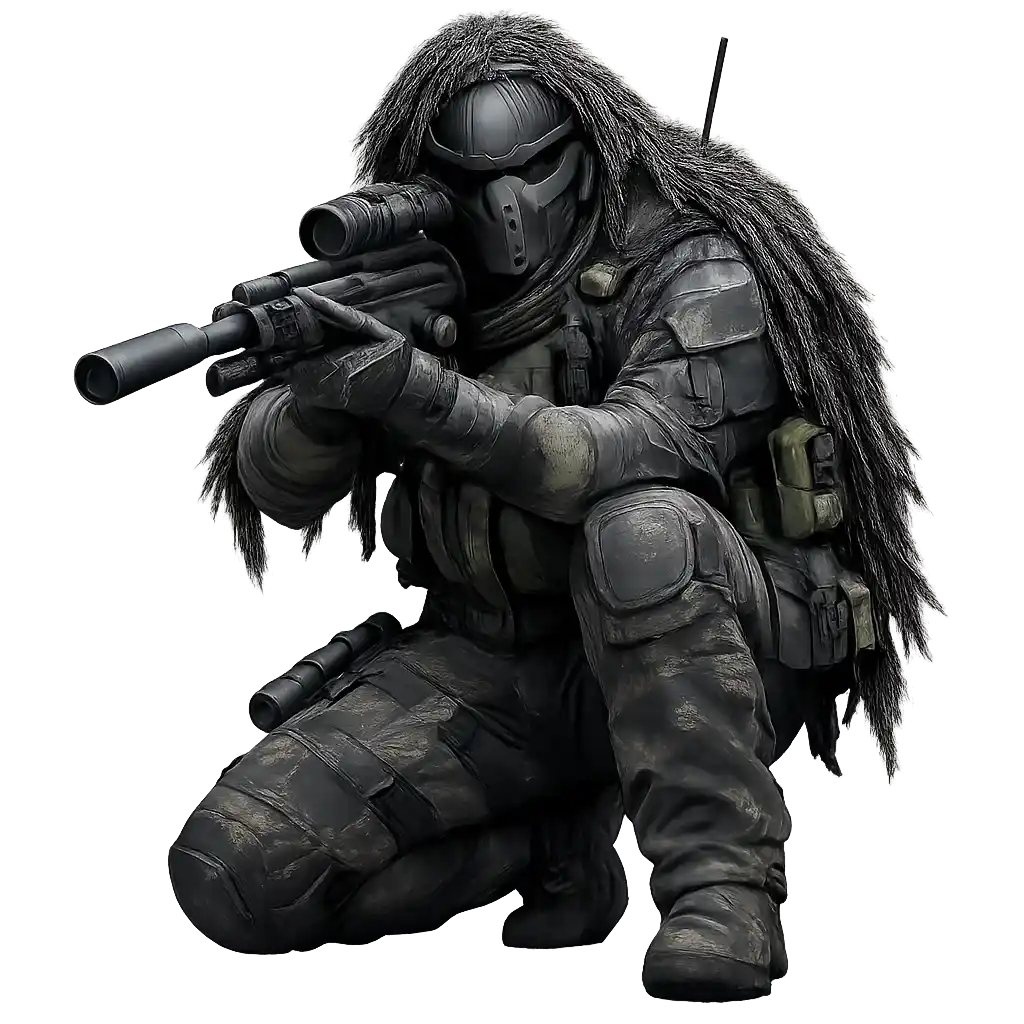
What makes it special isn’t just size — the whole thing was designed from the ground up around naval combat. Instead of vehicles being an option on a land map, boats are the connective tissue that holds Tsuru Reef together. Miles of coastline, open water, reef systems, and multiple land zones all linked by sea travel, with a dynamic wave system baked into the design rather than tacked on. It’s DICE’s purest expression of combined-arms warfare — land, air, and sea all contested at once.
For context on scale: before Season 4, Battlefield 6 had 15 multiplayer maps and 58 weapons. Pacific Front added Tsuru Reef plus three guns — the EF88 assault rifle, the BROD 3 carbine, and the DRM VSSM subsonic marksman rifle.
Tsuru Reef Map Layout — All Six Islands Explained
Now that the map is live, here’s how it actually breaks down — and it’s not quite what the pre-launch leaks suggested.
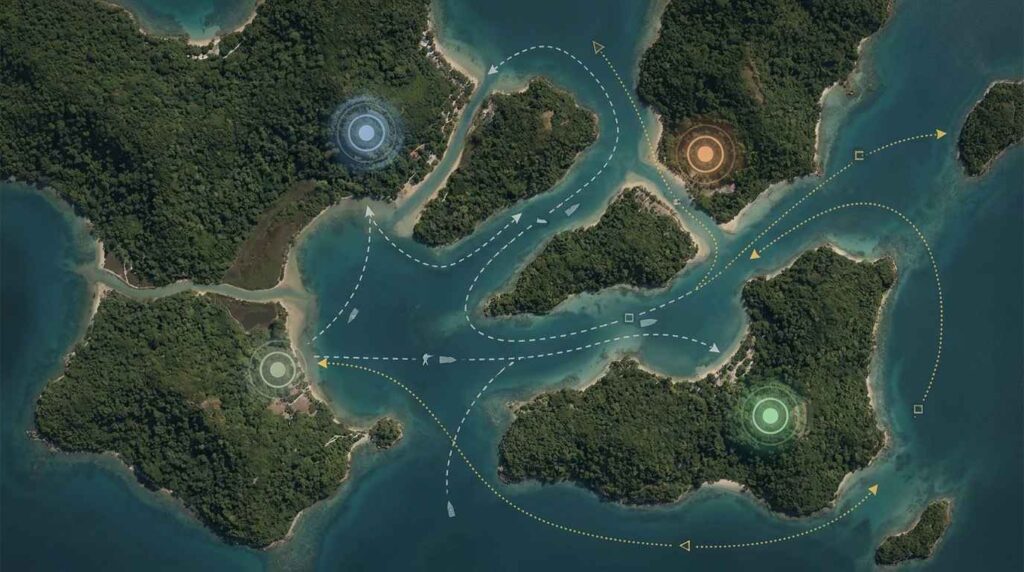
Tsuru Reef is built from six islands strung together by open ocean and shallow waterways: four combat islands — Yumeji, Kaze, Dusk, and Mist — plus two smaller home islands, one each for NATO and Pax Armata, acting as naval staging bases with boat and vehicle spawns. A large chunk of the map is open water, so the size doesn’t translate into constant long infantry runs the way you’d expect.
The key thing that trips people up: Tsuru Reef doesn’t use letter flags. There’s no A-through-I designation like older Battlefield maps. Instead, each island holds named points of interest, and each plays completely differently depending on whether you arrive by boat, on foot, or from the air. Callouts here are place names, not letters — so learn the island names now, because that’s what your squad will be shouting.
Kaze Island — Mifune Landing & Tsuru Gate (The Center of the Map)
This is the most important island on Tsuru Reef, and the one new players underrate. Kaze Island holds Mifune Landing and Tsuru Gate, two narrow landing points that form the central rotation anchor of the entire map. Squads push northwest, northeast, or south from here using rocks and vegetation for cover.
Holding Kaze isn’t about one flag — it’s about preserving access to every surrounding island. Whoever controls the center controls the rotations, and a team that loses Kaze ends up taking the long water route to everything. Contest this first.
Yumeji Island — Majestic Ikoi Resort
Yumeji is home to the Majestic Ikoi Resort, a freshly renovated luxury vacation spot and the map’s marquee infantry fight — a deliberate nod to Battlefield 4’s Hainan Resort. It’s tight hotel-room fighting mixed with outdoor pools and exposed exterior spaces: close-range weapons dominate indoors while rifles and DMRs stay useful outside. The hotel and villas are heavily destructible, so cover shifts as the match goes on, and the upper floors double as some of the strongest overwatch positions on the map. Whoever controls those floors dictates the ground around them.
Dusk Island — Moon Shore & Sunrise Harbor
Dusk Island holds Moon Shore and Sunrise Harbor, a zone of close-quarters fighting around the harbor structures. It’s a key staging point for controlling the boat lanes on that side of the map — securing the RCB-90 patrol boat here lets you dominate the water routes into the center.
Hitode Lagoon — The Sniper Perch
The cliff above Hitode Lagoon is the position long-range players want to learn early. It’s the premier sniper perch on the map — long sightlines over open water, a clear view of boat approaches, and enough elevation to spot incoming amphibious pushes before they land.
How to Actually Win Conquest on Tsuru Reef
The structural logic is simple once you know the islands: contest Kaze in the center hard enough to hold the enemy’s attention, then run a boat squad around the outside to flip lightly-defended islands like Dusk and Mist and bleed tickets. Because canals and open water separate everything, rotations take real time — a coordinated boat push can flip two points before the enemy repositions.
The team that only fights in the middle loses to the team that fights in the middle and flanks by sea. Don’t think of Tsuru Reef as separate islands — think of it as one battlefield connected by boats, helicopters, and forward spawns.
Boats & Naval Vehicles — Your Lifeline on Tsuru Reef
Two new watercraft anchor the fighting, and knowing when to use each is fundamental to the map:
- RCB-90 Patrol Boat — a fast, heavily armed interceptor that can shred enemy aircraft and light armor. Crucially, it works as a mobile spawn point, making it your squad’s tool for commanding the coastline and staging assaults on contested islands. This is your workhorse for pushing objectives and supporting a flank.
- 7.7m NSW RHIB — a lighter, faster rigid-hull boat built for racing through the surf. Use it for quick flank runs, steal-capping edge points, and repositioning fast when you don’t need the RCB-90’s firepower.
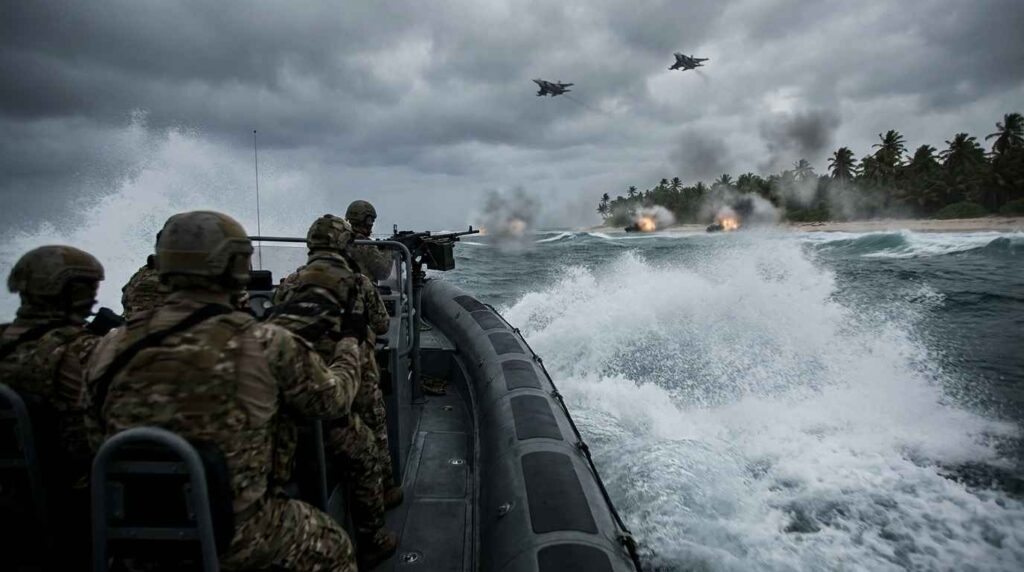
Season 4 also brings operational aircraft carriers with functional flight decks — you can move around the carrier, spawn on it, and launch jets or helicopters directly from the deck. On Tsuru Reef, the carrier acts as a mobile strategic base, which fundamentally changes how your team stages attacks: you’re not always pushing from a fixed spawn, you’re projecting force from the sea.
The main islands also have their own vehicle spawns — including fast attack vehicles on the more open islands — plus gun emplacements dotted around for anti-boat and anti-air defense. Grabbing a land vehicle after you’ve boated onto an island is often how you push inland to the actual objective.
How to Use the Dynamic Wave System
This is the mechanic that makes Tsuru Reef’s naval combat more than boats on a flat pond. Wave physics actively impact both traversal and firing while you’re out at sea — and smart players will weaponize that.
- Waves as cover. A boat dropping into a wave trough briefly breaks line of sight. Time your crossings so you’re using swells to mask your approach to a contested island rather than driving in a straight, predictable line.
- Waves disrupt aim. Firing from a pitching boat throws off your accuracy, so don’t expect to snipe cleanly from open water — close the distance or beach the boat before committing to a firefight.
- Rough water favors the mobile. If you’re in the faster RHIB, use choppy conditions against slower, heavier targets that can’t reposition as quickly.
The ocean is an active participant on Tsuru Reef, not a backdrop. Players who learn to read the water will consistently out-position those who treat it as flat terrain.
Best Class & Loadout Advice for Tsuru Reef
A naval map shifts what each class brings. Here’s how to stay relevant no matter how you play:
- Engineer — the MVP class on Tsuru Reef. Anti-vehicle launchers are essential for dealing with enemy boats, carrier-launched aircraft, and land vehicles. An engineer squad on an RCB-90 can lock down a waterway completely.
- Recon — the long sightlines over open water make marksman rifles genuinely strong here, and spotting enemy boats before they land gives your team the jump. The cliff above Hitode Lagoon is your home.
- Assault — your job is winning the island firefights once the boats land, especially inside the Majestic Ikoi Resort on Yumeji Island. Bring mobility and close-to-mid-range weapons for the vertical grind.
- Support — resupplying a dug-in squad holding a contested island is huge on a map where rotating back for ammo means a long boat ride. Keep your team fighting without leaving the point.
The golden rule for infantry: never cross open water on foot. You’re a free kill swimming between islands. Always take a boat, always move with a squad, and treat every island as a beachhead you’re assaulting rather than a point you can casually walk onto.
Avoiding the “Dead Zone” Trap
Naval maps in previous Battlefield titles often struggled with too much empty space between objectives — the dreaded dead zone where you spend more time traveling than fighting. DICE tuned Tsuru Reef’s engagement distances and capture-point placement around real Battlefield Labs player data before launch, and early impressions suggest it mostly landed — but you can still play into or around the problem.
The fix is simple: don’t take the long way. Spawn on forward assets — the RCB-90, the carrier, a squadmate on a contested island — instead of always launching from your home base. Every second you spend driving an empty stretch of water is a second you’re not on an objective. The players who feel like Tsuru Reef is “too big” are usually the ones spawning at base and driving across the whole map; the players who love it are spawning forward and fighting constantly.
What’s Coming Next in Season 4
Pacific Front is only phase one. The rest of the season is dated:
| Phase | Date | What Drops |
|---|---|---|
| Pacific Front | July 21 ✅ Live | Tsuru Reef, naval vehicles, EF88, BROD 3, DRM VSSM |
| Top Gun | August 18 | Wake Island returns, F-14 Tomcat, Carrier Strike mode, official Top Gun collab |
| Tidal Strike | September 15 | Themed event, diver’s knife, REDSEC updates with proximity chat |
Carrier Strike is the one to watch — a mode built around destroying enemy aircraft carriers, which should pair naturally with everything you’re learning on Tsuru Reef now.
On balance: core multiplayer tuning stayed largely untouched in 1.4.1.0. Most weapon changes targeted Ranked Battle Royale, including nerfs to grenade launcher ammo, so your existing multiplayer loadouts carry over intact.
Learn Tsuru Reef Before Everyone Else Does
The first two weeks on a brand-new map are when knowledge is worth the most — half the lobby still doesn’t know where the canals go or which resort floor wins the fight. That window closes fast.
For more Battlefield 6 map breakdowns, weapon tier lists, and seasonal guides across every update, dive into our latest gaming guides and updates.
Conclusion
Tsuru Reef is the most ambitious map in Battlefield 6, and it plays like it — six islands where boats are king, Kaze Island’s center decides matches, the Majestic Ikoi Resort delivers the biggest firefights, and the ocean itself is a weapon. Learn the resort’s floors, take the Hitode Lagoon cliff when you want to open fights at range, master the RCB-90 and RHIB, use the waves for cover, bring an engineer, and never swim when you can sail.
The map is live now, and map knowledge is worth more in these first two weeks than at any other point in the season. Get your boat routes down before the rest of the playerbase does. Wake Island and Carrier Strike land August 18 — everything you learn here transfers straight into them.
FAQs
When did Tsuru Reef release in Battlefield 6?
Tsuru Reef launched on July 21, 2026 with Battlefield 6 Season 4: Pacific Front via game update 1.4.1.0, with content unlocking at 12:00 UTC. Wake Island follows on August 18 in the Top Gun phase, alongside the F-14 Tomcat and Carrier Strike mode.
Is Tsuru Reef the biggest map in Battlefield 6?
Yes. Tsuru Reef is officially the largest map in Battlefield 6 history, surpassing Railway to Golmud from Season 3 — which was itself nearly four times the size of Mirak Valley. It’s a Pacific archipelago of six islands built from the ground up around naval combat across land, sea, and air.
How does Conquest work on Tsuru Reef?
Tsuru Reef is built from six islands — four combat islands (Yumeji, Kaze, Dusk, and Mist) plus one home island per faction. Unlike older Battlefield maps, it doesn’t use letter flags; each island holds named points of interest instead. Kaze Island, holding Mifune Landing and Tsuru Gate, is the central rotation anchor and the most important area to control, while boat squads flank around the outside to flip the other islands.
Where are the best sniper spots on Tsuru Reef?
The cliff above Hitode Lagoon is the standout sniper position — long sightlines over open water and a clear view of incoming boat approaches. The upper floors of the Majestic Ikoi Resort at the center of the island chain are the other strong overwatch option, with the added benefit of contesting the map’s most important point at the same time.
What boats are on Tsuru Reef?
Tsuru Reef features two new watercraft: the RCB-90 Patrol Boat, a fast heavily-armed interceptor that doubles as a mobile spawn point, and the 7.7m NSW RHIB, a lighter fast boat for flanking and quick repositioning. The map also has operational aircraft carriers with functional flight decks that act as mobile spawn and staging bases.
What new weapons came with Tsuru Reef?
Season 4: Pacific Front added three weapons at launch — the EF88 assault rifle, the BROD 3 carbine, and the DRM VSSM subsonic marksman rifle. A melee weapon, the diver’s knife, arrives in the Tidal Strike phase on September 15.
How do you play infantry on a naval map like Tsuru Reef?
Never cross open water on foot — you’re a free kill swimming between islands. Always take a boat, move with your squad, and treat each island as a beachhead. Engineer is the strongest class for dealing with enemy boats and vehicles, while Recon benefits from the long sightlines over open water. Spawn on forward assets like the RCB-90 or carrier to avoid long travel times.
What is the dynamic wave system on Tsuru Reef?
The dynamic wave system means ocean wave physics actively affect gameplay — waves can be used as cover to break line of sight, they disrupt your aim when firing from a moving boat, and rough water favors faster, more maneuverable craft. It makes the ocean an active part of combat rather than flat terrain, rewarding players who learn to read the water.
Sources & Methodology
Map details, layout, and season information reflect Battlefield 6 Season 4: Pacific Front on game update 1.4.1.0, live since July 21, 2026, compiled from EA and Battlefield Studios’ official Season 4 material and post-launch community mapping as of 23 July 2026. Named locations reflect confirmed in-game points of interest; the map uses named POIs rather than lettered flag designations. Later Season 4 phase dates are per EA’s published roadmap and may shift.
- GamingBolt — Battlefield 6 Season 4 Tsuru Reef developer update (official)
- Shane the Gamer — Season 4: Pacific Front launch coverage (update 1.4.1.0)
Battlefield 6 is a trademark of Electronic Arts Inc. This article is independent analysis and is not affiliated with or endorsed by EA or Battlefield Studios. Map details and layouts are subject to change with updates; details reflect the date of publication.