


When VALORANT launched, it entered the scene with a very clear goal—to challenge Counter-Strike as the dominant tactical shooter. While it didn’t completely replace Counter-Strike, it did something just as significant: it forced competition.
Counter-Strike: Global Offensive, which had long suffered from inconsistent developer attention, suddenly had a serious rival. Riot’s approach to live-service updates, structured esports, and consistent content gave VALORANT a strong foothold almost immediately.
Fast forward more than five years, and VALORANT is now:
- One of the most-played competitive shooters
- One of the most-watched esports globally
- A structured ecosystem built around the VALORANT Champions Tour (VCT)
Now, Riot is preparing for its biggest esports shift yet.
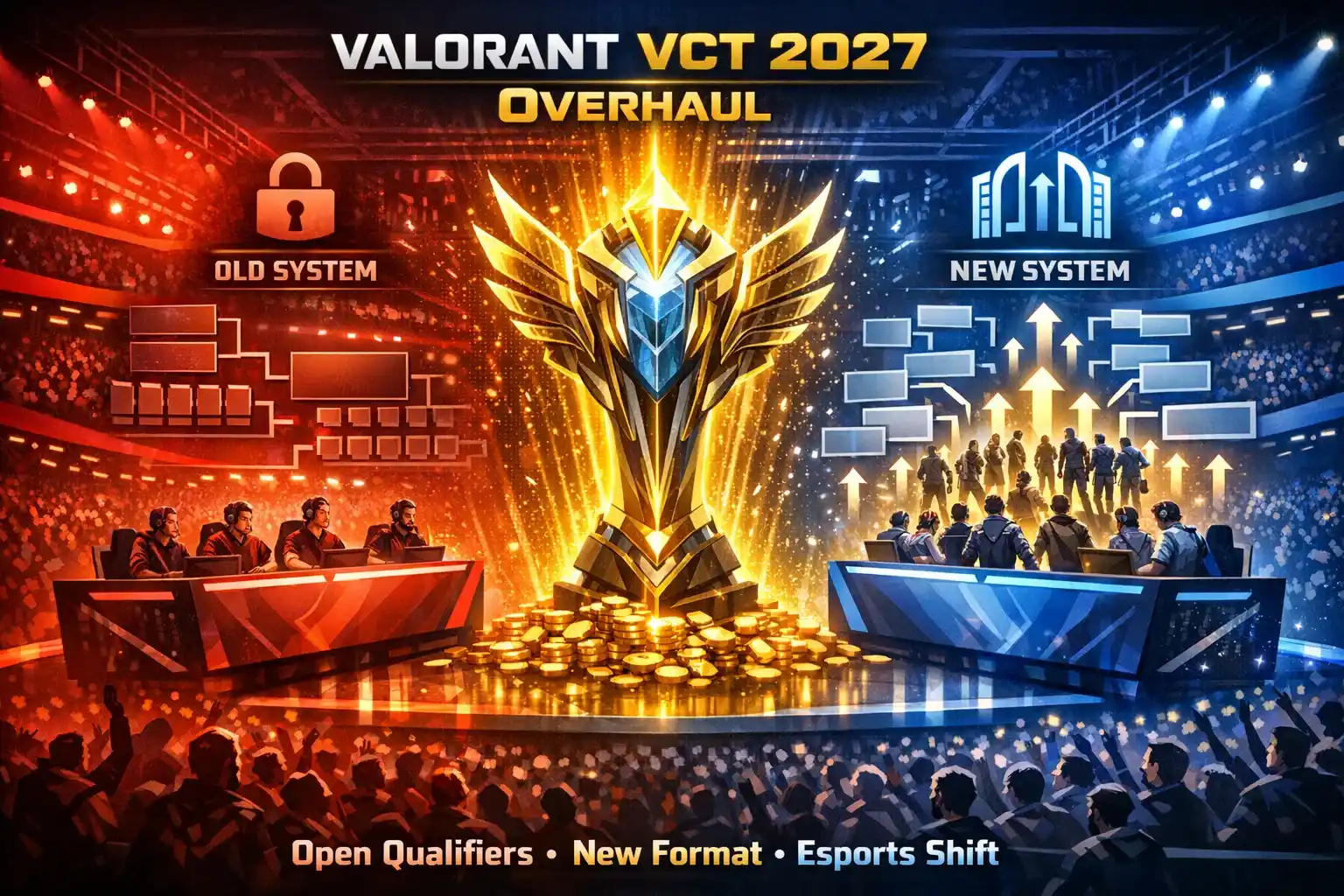
The company has officially announced a major overhaul of the VCT system starting in 2027, fundamentally changing how teams qualify, compete, and sustain themselves financially.
Struggling to reach your true rank in VALORANT? Many players get stuck due to inconsistent teammates, poor matchmaking, or inaccurate placement games. With ImmortalBoost’s VALORANT Placement Boosting, you can secure the rank you deserve and start your competitive climb from the right tier.
Related Guides:
When Will the VCT Changes Take Effect?
The announced changes will not impact the current season.
- Current VCT format → remains active through 2026
- New system → begins in VCT 2027 season
This gives teams, organizations, and players enough time to prepare for what is essentially a complete structural reset of VALORANT esports.
Why Riot Is Changing the VCT Format
The core reason behind this overhaul is simple: accessibility and competitiveness.
The current VCT system is largely closed, meaning:
- Only partnered teams have consistent access
- Tier 2 teams must grind through limited pathways
- New talent has fewer opportunities to break into top-tier events
Riot’s new direction shifts toward an open ecosystem, where:
- More teams can compete
- Entry barriers are reduced
- Talent discovery becomes faster and more organic
This is not just a format change—it’s a philosophical shift toward a more merit-based competitive system.
Open Access System (Biggest Change)
The most impactful update is the introduction of open qualifiers for major events.
How It Worked Before
Previously:
- Teams had to qualify through Tier 2 circuits
- Progression required time, funding, and consistent performance
- Entry into VCT was limited and controlled
How It Will Work in 2027
Now:
- Every Masters and Champions event will begin with open qualifiers
- Any team can register and compete
- Qualification is based purely on performance
What This Means
This change introduces:
- True open competition
- Faster entry for rising teams
- More unpredictable tournament outcomes
In practical terms:
- Amateur teams now have a direct path to global stages
- Non-partnered teams no longer need to wait an entire season
This is one of the most significant democratizations of esports competition in recent years.
New VCT Format: Introduction of VCT Cups
Riot is also removing the traditional league system.
Old System
- Regional leagues
- Long seasons
- Structured progression across months
New System (VCT Cups)
The league system will be replaced by VCT Cups.
Key Features of VCT Cups
- Two cups per region annually
- Total of 8 global cups per year
- Hosted on LAN (offline events)
- Short duration (around one week per event)
- Played in front of live audiences
Why This Matters
This new structure:
- Increases event frequency
- Reduces downtime between tournaments
- Keeps the competitive scene more active
It also creates:
- More high-stakes matches
- Faster storylines (teams rising or falling quickly)
- Greater viewer engagement due to shorter, intense events
Partnership Model Changes
The current partnership system is set to expire in 2027, and Riot is redefining how it works.
What Stays the Same
Partnered teams will still receive benefits—but with reduced exclusivity.
Key Benefits for Partnered Teams
1. Guaranteed Payments
- Teams receive annual financial support from Riot
- Payments scale based on performance
This ensures stability for established organizations.
2. Seeding Advantages
- Partnered teams skip early open qualifiers
- Enter tournaments at later stages
This gives them:
- Competitive advantage
- Reduced risk of early elimination
3. Revenue from In-Game Items
- Teams earn a share from:
- Skins
- Bundles
- Team-branded cosmetics
This has already proven to be a major revenue stream in previous VCT seasons.
What Changes
Even with these perks:
- Partnered teams no longer control access to top-tier competition
- Non-partnered teams can now compete directly
This creates a balance between:
- Stability (for partnered teams)
- Opportunity (for new teams)
Increased Financial Support Across the Ecosystem
Riot is also expanding financial incentives beyond partnered teams.
Prize Pool Expansion
- Total prize pool → $6 million
- Rewards increase across stages:
- Qualifiers → lower payouts
- VCT Cups → higher payouts
- Masters → even higher
- Champions → highest rewards
This creates a clear financial progression ladder.
Revenue Sharing for Non-Partnered Teams
For the first time:
- Non-partnered teams will also receive:
- A share of in-game item revenue (if they reach main events)
This is a major shift toward financial inclusivity.
Travel and Logistics Support
Riot confirmed that teams qualifying for global events will receive:
- Visa support
- Flight coverage
- Accommodation assistance
This removes one of the biggest barriers for international competition.
What This Means for Players and Teams
For Amateur and Semi-Pro Players
This is the biggest opportunity shift:
- Direct path to global tournaments
- No reliance on long Tier 2 systems
- Faster recognition and exposure
For Established Teams
- Still retain advantages
- Must adapt to more competition
- Cannot rely solely on partnership status
For Fans and Viewers
Expect:
- More diverse teams
- More unpredictable outcomes
- More frequent high-stakes matches
This could significantly increase viewership and engagement.
Key Takeaways (Quick Summary)
- VCT 2027 introduces a fully open qualifier system
- Traditional leagues are replaced by VCT Cups
- Partnership model remains, but with reduced exclusivity
- Prize pool increases to $6 million
- Non-partnered teams gain financial support
- Riot covers travel and logistics for qualified teams
Conclusion
The VCT 2027 overhaul is one of the most important changes in VALORANT esports history.
Riot is shifting from a controlled, closed system to a more open and competitive ecosystem, where performance matters more than status.
This change will likely:
- Increase competition at all levels
- Bring new talent into the spotlight
- Make tournaments more dynamic and unpredictable
While the system won’t go live until 2027, its impact is already shaping how teams prepare for the future.
For players, organizations, and fans, one thing is clear:
VALORANT esports is entering a new phase—and it’s going to be far more competitive than ever before.
FAQ (VALORANT Champions Tour)
When will the new VCT format start?
The new VALORANT Champions Tour format will officially begin in 2027. The current system will remain unchanged until the end of the 2026 season.
What is the biggest change in VCT 2027?
The biggest change is the introduction of open qualifiers for Masters and Champions events, allowing any team to compete for a spot on the global stage.
Are VALORANT leagues being removed?
Yes. Riot is replacing the traditional league system with VCT Cups, which are shorter, high-intensity LAN tournaments held multiple times a year.
Can non-partnered teams qualify for major tournaments?
Yes. With the new system, non-partnered teams can qualify directly through open qualifiers, without waiting for a full season.
What is the total prize pool for VCT 2027?
The total prize pool is expected to be around $6 million, with increasing rewards at each stage from qualifiers to Champions.