Fellowship is what you get when the endgame dungeon runs of an MMO meet the tight, hero-based teamplay of a MOBA — its developers call it a MODA (multiplayer online dungeon adventure). If you’ve ever loved five-manning a hard dungeon, this is that experience distilled into fast, replayable runs. This beginner’s guide is fully updated for Season 3: Rise of the Heskyr, the game’s biggest patch yet, and walks you through everything a new player actually needs: the roster of all 12 heroes, every game mode, how gear and the new Itemization 2.0 system work, the account-wide currencies, and the fastest route to real progression.
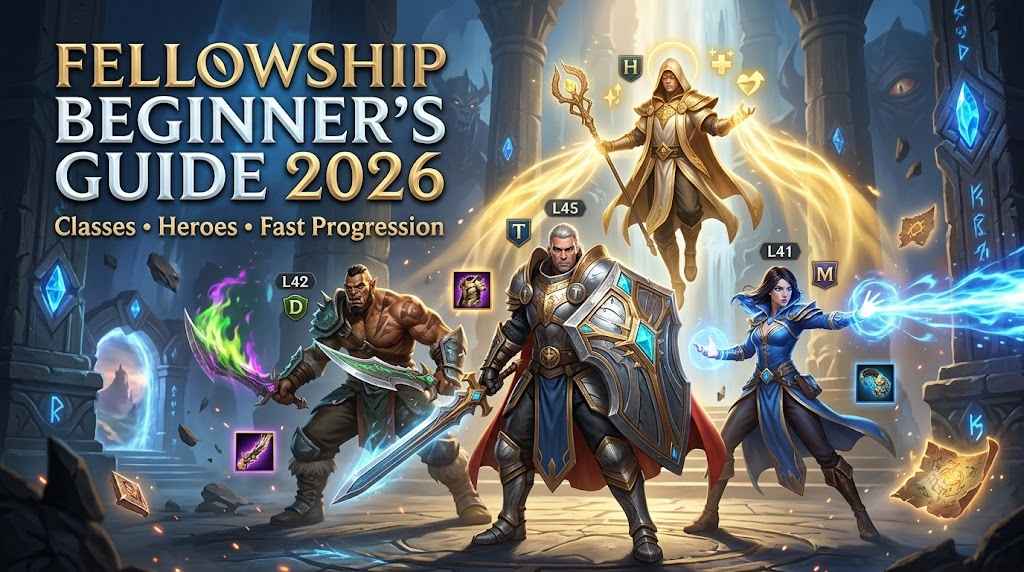
Quick start: Fellowship is in Steam Early Access ($24.99), currently on Season 3. Do the tutorial, warm up in the Woodland Glade (Adventure mode), then run Quickplay to gear up before entering the ranked Challenger Leagues. Pick a Tank or an easy Healer/DPS first, rush the Starmap’s left path for a free high-level weapon, and keep your Item Level rising above everything else.
What Is Fellowship? (2026 State of the Game)
Fellowship is a co-op, four-player dungeon crawler built entirely around the classic role trinity: one Tank, one Healer, and two DPS per party. There’s no open world to grind or character creator to fuss over — you pick a pre-made hero (each with their own kit and story) and jump into instanced dungeons that scale in difficulty as you climb.
Since launch it has moved fast. Season 2 (February 2026) added a beginner onboarding zone and two heroes; Season 3: Rise of the Heskyr (June 2026) then delivered the biggest overhaul so far: a new hero, new dungeons, a blood-themed enemy faction, endgame Pinnacle Dungeons, and a complete gear rework called Itemization 2.0 (aka Loot 2.0). If you bounced off the game early in Early Access, it’s a substantially different — and much more beginner-friendly — experience now.
Heads-up on seasonal resets: Each new season resets gear, talents, currencies, and ranks so everyone starts on a level playing field. Your cosmetics and mounts are never reset, so those unlocks are permanent. Starting fresh as a beginner during a new season is actually the ideal time to jump in.
Want to skip the early grind and jump straight into serious dungeons? ImmortalBoost’s Fellowship services can gear you up, push your Challenger League rank, and hand you the loot you need to compete from day one.
Where to Start as a Beginner
When you spawn into the Stronghold (your hub), look for the Game Finder table — that’s how you queue into content. Before diving into ranked play, work through these in order:
- The tutorial teaches core combat with a single hero and is genuinely worth doing — it shows you how every hero broadly operates.
- Adventure (Woodland Glade) is the pressure-free zone added for new players. You roam solo or with up to three others, fight mobs, do small quests and boss events for Gold and Supplies, and progress your Starmap. It’s the best place to test heroes and learn a role without ranked pressure.
- Quickplay is your gear-up mode: untimed, Item-Level capped dungeon runs that reward Quartermaster Tokens and Cache Keys to build up your equipment.
- Challenger Leagues is where you’ll live once you’re comfortable — the ranked ladder with real loot.
Fellowship Game Modes Explained
| Mode | Best for | What you get |
|---|---|---|
| Adventure (Woodland Glade) | Learning heroes, casual play, Starmap progress | Gold, Supplies, ability unlocks, low pressure |
| Quickplay | First gearing, learning dungeons | Quartermaster Tokens, Cache Keys, steady Supplies (untimed, ILVL-capped) |
| Challenger Leagues | Main progression once geared | Proper loot + all Quickplay resources; timed, ranked |
| Eternal | Endgame after climbing the leagues | Top-tier challenge, high-end gear, item Tempering |
| Pinnacle Dungeons | Hardest endgame (Season 3) | Three difficulties, weekly rewards, rare gear and mounts |
The Challenger Leagues ladder runs through four tiers — Contender, Adept, Champion, and Paragon — each with seven sublevels that add difficulty modifiers called Curses. The first six dungeons in a run are single-boss; the seventh has three bosses, and clearing it promotes you to the next league (beat Contender +7 to reach Adept, and so on).
Classes: Tank, Healer, DPS
Every hero fits one of three roles. Understanding what each is responsible for is the fastest way to stop feeling lost in a dungeon:
- Tank — holds enemy aggro, positions the pack, and eats the big hits. Your job is protection first: if you can either land a finishing blow or shield a low ally, shield the ally.
- Healer — keeps everyone (especially the Tank) alive and usually acts as the shot-caller, since you have the best view of the fight. Awareness matters more than raw healing numbers.
- DPS — deals the damage. The simplest role to pick up but often the hardest to master, because top DPS means knowing boss patterns and every other role well enough to maximize uptime.
Each hero has 18 talents with 13 points to spend, and you can respec for free any time you’re in the Stronghold — so experiment freely; you can’t permanently ruin a build.
All Fellowship Heroes (Season 3 Roster)
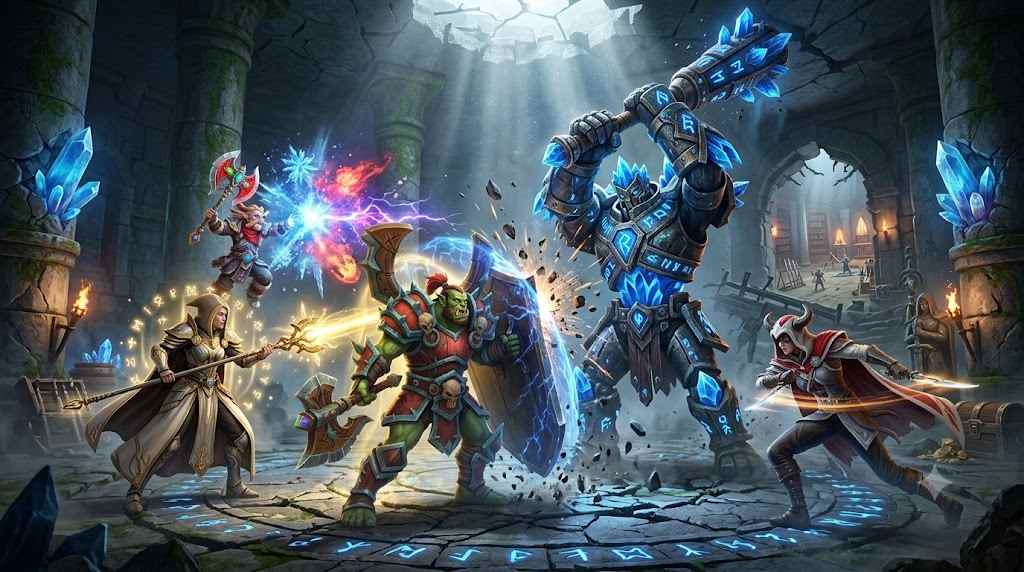
The roster has grown to 12 heroes — 3 Tanks, 3 Healers, and 6 DPS. Remember you’ll bring exactly one Tank, one Healer, and two DPS into each dungeon. Since Gold and Supplies are account-wide, leveling alts is quick, so don’t be afraid to try several.
| Hero | Role | Beginner notes |
|---|---|---|
| Helena | Tank | Great against crowds, high damage; strong, forgiving beginner tank. |
| Meiko | Tank | Mobility- and buff-focused; excellent on bosses, weaker vs crowds. |
| Xavian (newer) | Tank | Shields and heals allies; shines on trash pulls, trickier on hard bosses. |
| Sylvie | Healer | Pet-based sustained healing; the safest, easiest healer to start with. |
| Vigour | Healer | Reactive burst healing with finicky mana; not ideal for total beginners. |
| Aeona (newer) | Healer | Time-manipulation kit that delays incoming damage; higher skill ceiling. |
| Rime | DPS | Frost caster with huge AoE and burst; simple and beginner-friendly. |
| Tariq | DPS | Melee with big single-target and AoE; some resource management. |
| Elarion | DPS | Ranged bowman; high skill ceiling, strong safe sustained damage. |
| Ardeos | DPS | Fire damage-over-time caster; straightforward resource management. |
| Mara | DPS | Stealthy rogue, single-target burst; weak early, spikes later. |
| Gunde (Season 3) | DPS | Axe-wielding berserker built around bleed/Rend stacks; big close-range output. |
Best beginner picks: For a smooth start, Helena (Tank), Sylvie (Healer), and Rime (ranged DPS) are the most forgiving and perform well even in random groups. Save the finesse heroes (Vigour, Aeona, Elarion, Mara) until you know the dungeons.
Account-Wide Currencies
Three currencies are shared across all your heroes, which is why building alts is painless:
- Gold — your main upgrade currency. Spend it at the Blacksmith to improve gear, reroll items, and (later) buy cosmetics. Early on, funnel gold into gear upgrades.
- Supplies — earned mostly in Quickplay and Adventure. Use them to buy Common gear from the Quartermaster to fill empty low-level slots fast, since progression is tied to Item Level.
- Marks of Fellowship — earned by completing dungeons. Traded to the Storekeeper for boxes of crafting resources used to reroll and modify gear.
Don’t burn your rare materials. Hold onto Aether and Mithril until you’ve decided which hero to main — they’re hard to get and are needed for the higher-end crafting that reshapes your gear.
Vendors You’ll Use Most
The Stronghold’s vendors are central to progression. The ones a beginner should know:
- Storekeeper (Keiren) — sells daily and weekly resource boxes. Visit every day; buy the weekly box first so it starts recharging sooner.
- Blacksmith (Bjorn) — upgrades and tempers your gear. Your best friend for most of the game.
- Jeweler (Cassian) — extracts gems from items for free, so you can move them around without penalty.
- Quartermaster (Novak) — trades Supplies for basic gear to plug empty slots.
- Outfitter (Brenhem) — cosmetics only, and expensive (up to ~15,000 gold). Skip until you’re flush.
- Master Craftsman (Braggi) — late-game transforming, gem recoloring, and trait rerolling. Needs Aether and Mithril, so don’t feed it before you’ve picked a main.
Two extras worth knowing: the Scrapper recycles unwanted gear of any rarity, and the Shrine of Infusion lets you slot weapon talents on Epic-and-above gear.
Gear & Itemization 2.0 (Season 3)
Season 3 rebuilt how loot works, and it’s a big win for new players. The key change: item level and item quality are now separate. When you clear a dungeon, the item you get is at that dungeon’s item level, while its quality (Common up through Legendary) rolls randomly and adds extra properties and special effects on top — it no longer changes the item level.
In practice, that means a lucky Legendary drop from accessible content is genuinely useful now, not dead weight. Two other beginner-friendly upgrades came with it: gems are account-wide (no more re-farming them for every alt), and instead of upgrading at the Blacksmith to raise item level, you now temper items there. Still, the golden rule holds: keep filling and raising your Item Level above chasing perfect secondary stats early on.
The Starmap
The Starmap is a reward track you progress by clearing dungeons and challenges. It has three paths:
- Left path (main progression) — talent points and new abilities. Rush this: clearing around 16 dungeons grants a random Item Level 90 weapon that trivializes most early content.
- Middle path — a mix of gear, currency, materials, and extra talent points.
- Right path — mounts and cosmetics, and these unlocks are permanent across resets.
Want to skip the early grind and jump straight into serious dungeons? ImmortalBoost’s Fellowship services can gear you up, push your Challenger League rank, and hand you the loot you need to compete from day one.
Essential Beginner Tips
- Learn the interrupt. Press V to target and F to Kick. Yellow enemy casts can be stopped by Kick or crowd control; gray casts can only be stopped by crowd control.
- Read the ground. A circle with arrows pointing inward means soak it as a group; a circle with a cyclone means get out. Standing in the wrong one wipes runs.
- Know your debuffs. Red-border debuffs can’t be dispelled; blue-border debuffs can be cleansed by healers.
- Prioritize Item Level early over secondary stats — it’s the single biggest driver of early power.
- Visit the Storekeeper daily and buy the weekly box first so it recharges.
- Try multiple heroes. Account-wide Gold and Supplies make alts cheap to gear, and knowing other roles makes you a better player in every seat.
- Don’t hoard. Scrap gear you won’t use for materials instead of letting it pile up.
- Respect crowd control. It deals no damage but creates free damage windows and eases pressure on the whole group.
- Keep moving and communicate. Most AoE can be side-stepped, and this is a co-op game — call out plans, especially with randoms.
Conclusion
Fellowship rewards understanding over raw reflexes, and the good news for newcomers is that Season 3 is the most welcoming the game has ever been — a proper tutorial, the low-pressure Woodland Glade, and a loot system that finally makes lucky drops meaningful. Nail the basics here — learn a role, warm up in Adventure, gear through Quickplay, rush the Starmap’s left path, and keep your Item Level climbing — and you’ll be clearing Challenger Leagues before you know it. From there, the Eternal and Pinnacle dungeons are waiting. Grab a hero you enjoy, queue up, and go get some loot.
For more Fellowship guides, hero breakdowns, and update coverage, dive into our latest gaming guides and updates.
Frequently Asked Questions
What should I do first in Fellowship?
Complete the tutorial, then spend time in Adventure (Woodland Glade) to learn a hero. From there, run Quickplay to build up your gear before entering the ranked Challenger Leagues.
What’s the easiest class for beginners?
Tank is generally the most forgiving thanks to a big health pool and defensive stats, with Helena being an easy, strong pick. If you prefer other roles, Sylvie (Healer) and Rime (ranged DPS) are the most beginner-friendly.
How many heroes are in Fellowship?
As of Season 3 there are 12 heroes: 3 Tanks (Helena, Meiko, Xavian), 3 Healers (Sylvie, Vigour, Aeona), and 6 DPS (Rime, Tariq, Elarion, Ardeos, Mara, Gunde). Each dungeon party uses one Tank, one Healer, and two DPS.
Can you play Fellowship solo?
You can solo-queue and roam the Woodland Glade alone, but dungeons are four-player content, so you’ll be matched with real players to fill the party. There’s no offline single-player mode.
How much is Fellowship and where can I get it?
It’s in Steam Early Access for $24.99 on PC. Other platforms may come later, but Steam is the only option for now.
Do seasonal resets delete my progress?
Seasons reset gear, talents, currencies, and ranks so everyone starts fresh, but your cosmetics and mounts are kept permanently. Starting during a new season is actually a great time for beginners.
What is the fastest way to gear up early?
Fill every gear slot quickly using Supplies at the Quartermaster, rush the Starmap’s left path (around 16 dungeons) for a free Item Level 90 weapon, spend Gold on Blacksmith upgrades, and keep Item Level as your top priority over secondary stats.